Commercial Real Estate Investment in Dubai, Yields, Fees and Risks

Commercial real estate investment in Dubai means buying an office, a retail unit or a warehouse for rental income. The real return does not come from the price and the asking rent, but from net income: after service charges, VAT, vacancy and repairs. On entry, budget for the 4% DLD fee and registration costs, and check the property before you sign, not after.
Below we cover how to calculate the rental yield, which costs come with buying and owning, how leases work through Ejari and what to check on site so you do not buy a problem along with the square footage.
Commercial Real Estate Investment in Dubai by Property Type
Commercial property in Dubai is really three markets with different tenants and a different income logic. An office depends on the business activity of the area and the quality of the building. A shop depends on footfall and frontage. A warehouse depends on logistics: roads, clear height, floor load and truck access.
| Property type | Who rents it | What drives income | Main risk |
|---|---|---|---|
| Office | Companies, branch offices, start-ups | Location, building grade, parking, fit-out condition | Vacancy between tenants, cost of a new fit-out |
| Retail unit | Shops, cafes, service businesses | Footfall, frontage, floor level, neighbours | Falling traffic, a long search for a new tenant |
| Warehouse | Logistics and trading companies | Truck access, height, floor load, power capacity | Outdated building specs, limits on permitted activity |
An office in a standalone building is usually easier to manage than a unit in a mixed-use complex, where the management company decides on repairs to common areas. In the office market a lot depends on the building grade, and we have covered what sets Class A offices in Dubai apart in a separate article. Warehouses are more often bought whole, together with the plot, so the permitted land use matters as much as the walls.
How to Calculate the Rental Yield
Sellers and brokers usually quote the gross rental yield: annual rent divided by the price. It is a handy figure for comparison, but an investor needs the net yield. From the rent you subtract service charges, insurance, maintenance, the property manager's fee and average vacancy, and to the price you add the DLD fee, the broker's commission and any initial works.
A simple example to show the logic (the figures are illustrative, not market data):
| Item | Amount |
|---|---|
| Office price | AED 2,000,000 |
| 4% DLD fee and registration | about AED 82,000 |
| Total outlay | about AED 2,082,000 |
| Annual rent | AED 160,000 (gross yield 8%) |
| Service charges, insurance, maintenance | minus AED 35,000 |
| One month of vacancy per year | minus AED 13,000 |
| Net income | AED 112,000 (net yield about 5.4%) |
Also work out what happens when a tenant changes. A new office tenant may ask for a refreshed fit-out, moved partitions or a few rent-free months for their works. For a warehouse it can mean new doors, lighting or a power upgrade. These costs do not come every year, but they should be spread over the whole holding period.
The gap between 8% and 5.4% is the price of not paying attention. Two properties with the same rent can give different net income just because of service charges or the state of the building services. So compare properties by net yield on the total outlay, not by price per square foot.
Buying and Holding Costs, DLD, Service Charges and VAT
Costs split into one-off costs at purchase and recurring costs while you own the property. The one-off costs are known in advance. The recurring ones are often underestimated.
| Cost | How much (as of 2026) | When it is paid |
|---|---|---|
| DLD transfer registration fee | 4% of the property value plus fixed admin fees | When the sale is registered |
| Mortgage registration at DLD | 0.25% of the loan amount | When buying with a loan |
| VAT on buying a commercial property | 5% of the price if the seller is VAT registered | At the sale |
| Service charges | Per the building's approved budget, in AED per sq ft per year | Yearly or quarterly |
| VAT on rent | 5% on top of the rent | With each rent payment |
Under the sale agreement the DLD fee is usually paid by the buyer, but the parties can agree otherwise. Add the broker's commission and the registration trustee's fee separately.
VAT on Commercial Property
Unlike housing, sales and leases of commercial property in the UAE carry VAT at the standard rate of 5%. If rent and other taxable supplies exceed AED 375,000 over 12 months, the owner must register for VAT. The upside of registering is that VAT paid on the purchase and on expenses can be recovered. The downside is the filing and bookkeeping. Settle this with a tax adviser before the deal, not after the first invoice to a tenant.
Corporate Tax
UAE corporate tax is 0% on taxable profit up to AED 375,000 and 9% above that. If a company buys the property, its rental income is part of its tax base. Income an individual earns from property held personally, not through a licensed business, is generally outside corporate tax. Buying in your own name or through a company affects both tax and how the asset is passed on later, so decide it early.
Service Charges
In jointly owned buildings, service charges cover security, cleaning and the upkeep of lifts, fire safety and air conditioning systems. RERA approves the budgets, and you can see the approved rates in the Dubai Land Department service charge index. Compare the building's rate with its neighbours and check the payment history: any arrears of the previous owner must be cleared before the transfer.
Leases, Ejari and Rent Increases
Every lease in Dubai is registered in the Ejari system. An unregistered lease is harder to defend in a dispute, and the tenant needs it for a trade licence and for utility connections. The Dubai Land Department builds its rental index on Ejari data, and that index is what your rent is compared with when the lease is renewed.
Rent increases on renewal are capped by Decree No. 43 of 2013. If your rent is no more than 10% below the index average, no increase is allowed. Above that the cap rises in steps: up to 5% when the gap is 11-20%, up to 10% at 21-30%, up to 15% at 31-40% and up to 20% when the rent is more than 40% below the average. Tenants must be notified of changes in advance, and disputes go to the Rental Dispute Settlement Centre.
For an investor this means one simple thing: if you buy a property with a tenant on a below-market rent, you cannot lift it to market level quickly. Calculate the yield on the current lease, not on the market rent you hope to get in a year.
Due Diligence Before You Buy
Checking the property is what separates successful commercial real estate investment in Dubai from expensive mistakes. A lawyer or registration trustee handles the legal side, an engineer handles the technical side. The minimum list:
- Ownership. Title deed, no encumbrances or debts, the area on paper matching the area on site.
- Permitted use. Office, retail and warehouse are different uses. If you plan to turn an office into a clinic or a cafe, you will need a change of use of the premises, and that is not possible everywhere.
- Building documents. Completion certificate, approvals for past alterations, Civil Defence fire safety compliance.
- Technical condition. Air conditioning, the main electrical panel and allocated load, roof, waterproofing, fire-fighting systems. Replacing a chiller or a panel can eat a year of income.
- Service charges and the building budget. Current rate, arrears, the management company's plans for major works.
- Tenant and lease. Term, rent, Ejari registration, payment history, early termination terms.
For a warehouse, also check truck access, clear height, floor load and power capacity. If the warehouse needs to be extended or rebuilt for a tenant, estimate the timeline and budget in advance: we have looked at how turnkey warehouse construction in Dubai works in detail.
Risks and Common Investor Mistakes
- Relying on the gross yield. Service charges, vacancy and repairs can easily cut a third of the income.
- Buying without a technical check. Old air conditioning and electrical panels in commercial buildings are a common hidden cost.
- The wrong permitted use. A unit bought for a cafe or clinic where the use cannot be changed, or only slowly.
- Forgetting VAT. 5% on the purchase and on rent changes the cash flow if it is not planned for.
- Betting on rent growth. Renewal caps will not let you raise the rent of a sitting tenant quickly.
- No fit-out budget. A new office tenant often asks for works or a discount on the first months.
Ready Property or Off-Plan
A ready property with a tenant earns from the first month, and you can check it on site: the state of the systems, real footfall, the quality of the management company. Buying off-plan is usually cheaper, and payments are spread over a schedule and go into the project's escrow account. In return the investor takes on the risk of delays, of the finished unit differing from the plan and of an empty period while the building fills with tenants. The 5% VAT also applies to off-plan purchases of commercial property.
If you choose a project on paper, look at the developer's track record, at who will manage the building after handover and at the finish you will get. A unit delivered as shell and core needs its own design and fit-out budget before the first tenant moves in, and that money belongs in the yield calculation from day one.
Concentration is a separate risk. One property with one tenant means that if that company leaves, your income drops to zero. A small warehouse and an office in different areas give a steadier cash flow than one large unit.
Frequently Asked Questions
Can a foreigner buy commercial property in Dubai?
Yes, in areas where foreign ownership is allowed (freehold) and in a number of free zones under their own rules. Before buying, check the status of the area and the master developer's conditions.
How much does it cost to complete a purchase?
The main item is the DLD fee of 4% of the property value. On top come admin fees, the registration trustee, the broker's commission, 5% VAT on a commercial property and 0.25% of the loan amount if you take a mortgage.
Do I pay tax on rental income?
There is no personal income tax in the UAE. A company that owns the property pays 9% corporate tax on profit above AED 375,000. 5% VAT on the rent of a commercial property is charged if the owner is VAT registered.
Which is better, an office or a warehouse?
There is no universal answer. A warehouse is usually simpler to run and is let on longer terms, while an office is more liquid and easier to sell. Compare specific properties by net yield and by the cost of preparing them for a tenant.
How ZeroMax Can Help
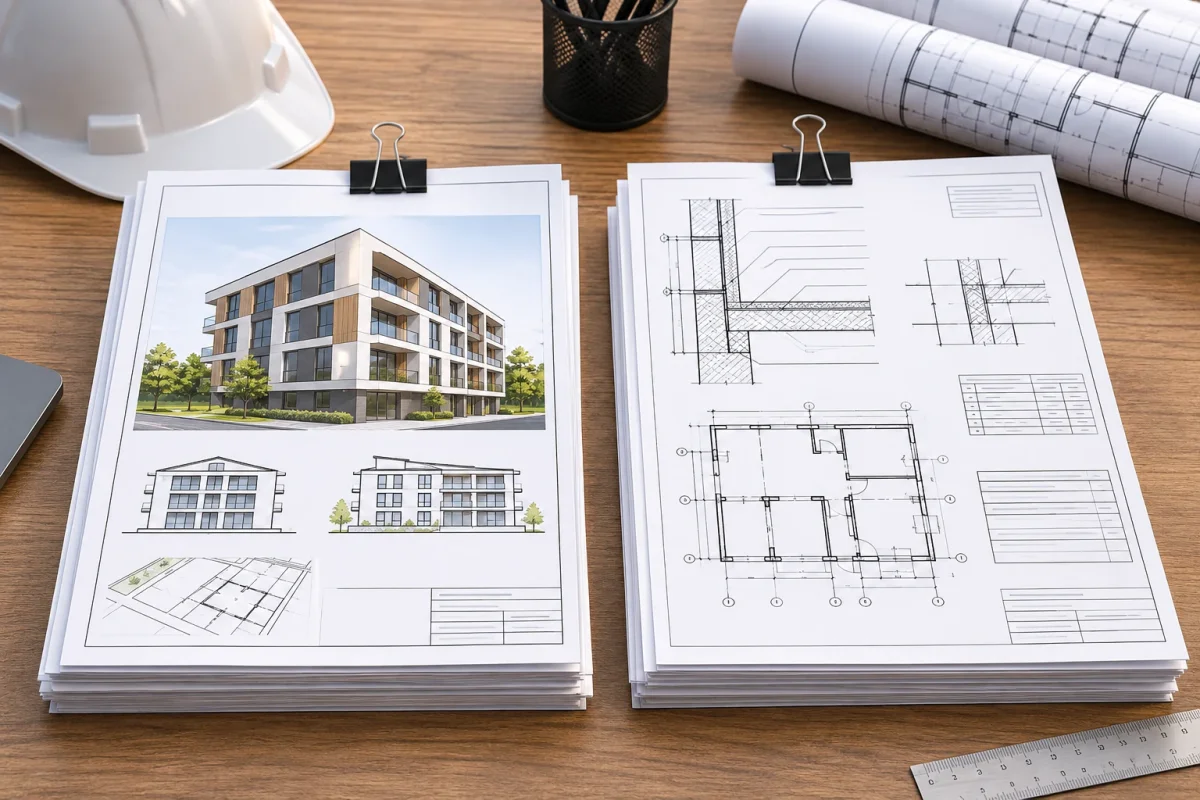
Commercial real estate investment in Dubai often involves work on the building itself: re-planning for a tenant, upgrading the building services, extending a warehouse or changing the use. ZeroMax Group carries out a technical assessment before you buy, prepares the design and construction documents, handles approvals with the Dubai authorities and provides technical and design supervision while a licensed contractor does the works. For offices we offer office building design, for logistics assets warehouse design, and before any works we prepare a cost estimate and BOQ so the budget goes into your yield calculation. Get in touch and we will assess the property and the cost of preparing it before you sign the contract.