
Signage Approval Dubai: A Practical Guide
September 1, 2026
Getting a sign approved in Dubai looks simple from the outside. You design a logo, choose a contractor, then wait for the municipality to say yes. In practice, the process touches several departments, requires technical drawings and NOC letters, and can create weeks of delay if you miss one detail. The good news? A structured approach makes it predictable. This guide explains how signage approval Dubai actually works and how to avoid the common mistakes that send applications back.
Why Signage Approval Matters in Dubai
Outdoor advertising is not a decoration. In Dubai, signs are part of the public realm. They communicate with drivers and pedestrians, preserve the look of a facade, and support the city's wayfinding logic. That is why each signboard must be approved before installation, and often before replacement or modification.
Operating without approval is risky. The authorities can issue fines, order the sign removed, and in some cases suspend your trade license. The cost of removal alone can be higher than the approval fee. Even a sign with an expired permit creates a legal headache for the business owner.
Approval also protects you from engineering problems. A sign mounted on a high-rise facade is exposed to wind loads, heat, and vibration. The technical review catches issues before they become safety hazards. So the process is not about bureaucracy. It is about making sure your advertising works without endangering people or property. Even if your business operates from a temporary structure, the same logic applies: events, kiosks, and seasonal counters all require some form of authorisation for their external branding.
Key Authorities and Regulatory Framework
There is no single sign authority in Dubai. Your route depends on where your business is located. Most applications go through Dubai Municipality, which controls land-use planning, building codes, and urban aesthetics across the city. In free zones like DMCC, Dubai Internet City, or Jebel Ali Free Zone, the free-zone authority manages approvals through Trakhees or similar portals.
Road-facing signs often require consent from the Roads and Transport Authority (RTA). If the sign hangs over a public footpath or is visible from a main highway, an RTA permit may be needed in addition to the municipality's approval. High-rise buildings also demand a no-objection certificate from the building owner and sometimes from the Civil Defence for fire safety reasons.
Before you prepare any documents, identify the correct jurisdiction. The wrong route leads to wasted time. A quick check of your tenancy contract and trade license usually tells you which authority is in charge. For a clear overview of business regulations across the UAE, the official UAE government portal is a reliable starting point.
Signage Types and Placement Rules
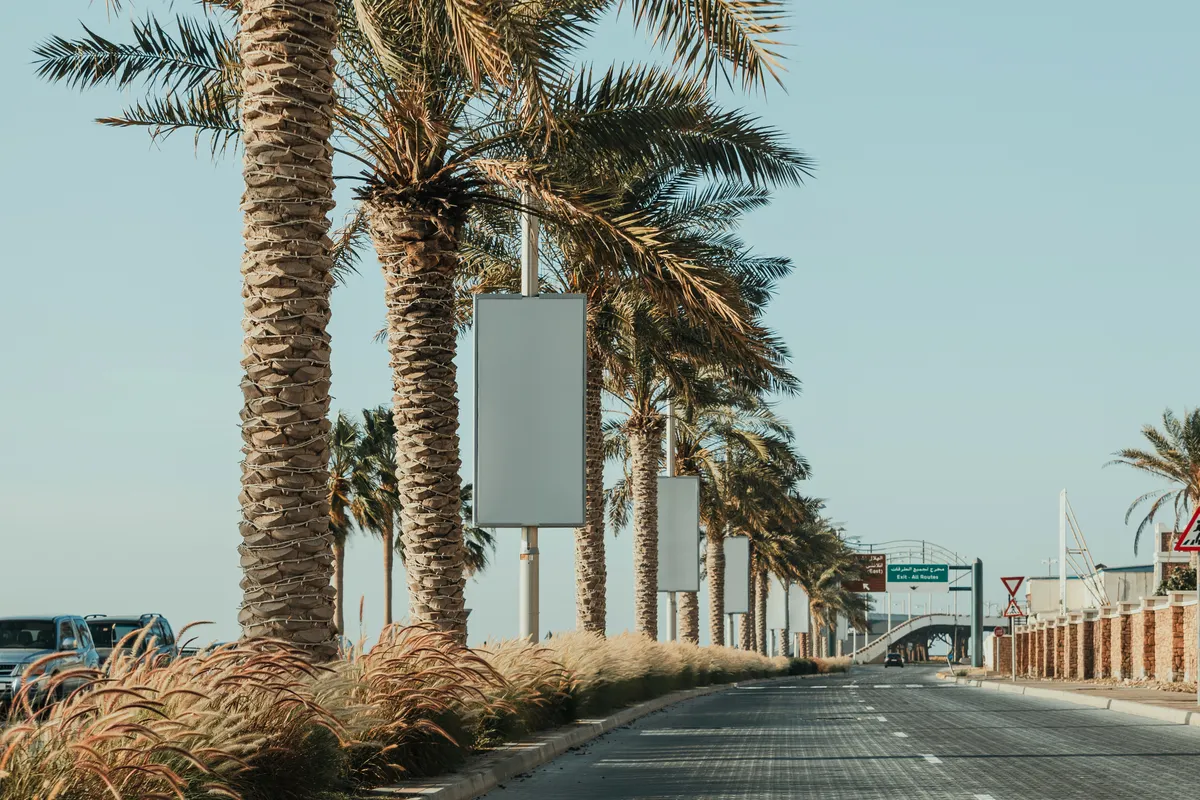
Not all signs are treated the same way. A small shopfront sign is different from a rooftop billboard, and the approval criteria reflect that. The table below shows the most common categories and what authorities usually want to see.
| Sign type | Regulatory route | Typical requirements |
|---|---|---|
| Building facade sign | Dubai Municipality / free-zone authority | Dimension limits, location on facade, Arabic and English text |
| Projecting sign | Dubai Municipality + owner NOC | Clearance above pavement, structural fixings, wind load |
| Awning or canopy sign | Dubai Municipality / Trakhees | Material durability, retraction or fixed design, lighting control |
| Window and door graphics | Depending on area, often municipality | No obstruction of vision, limited coverage, easy removal |
| Wayfinding and directional sign | RTA for public roads | Consistent design, minimal clutter, reflective or illuminated elements |
| Billboard / advertising board | Dubai Municipality + RTA if road-facing | Structural drawings, site-specific permit, time-limited license |
A common rule in Dubai is that a sign should not dominate the facade, block a neighbouring unit, or create visual confusion. Details such as maximum projection, height above pavement, and illumination levels are set out in the local design guidelines. For commercial units in mixed-use buildings, the developer's own signage strategy may impose extra rules. Better to check the building's design guidelines before ordering custom hardware.
Documentation and Approval Process
The approval process is largely document-driven. If your package is complete, the authorities can review it faster. Typical documents include:
- Completed application form from the concerned authority.
- Copy of the trade license and tenancy contract.
- Drawings of the sign with dimensions, materials, and colours.
- Facade elevation showing the exact position of the sign.
- Site photos and a summary of surrounding signage.
- Structural calculations and installation method statement.
- NOC from the building owner or developer.
- Other approvals such as RTA or Civil Defence, if applicable.
For most businesses, signage approval Dubai is not a single application but a short chain of reviews. The sequence usually starts with a preliminary review of the design. Once the authority gives initial approval, you can proceed to installation. After installation, a final inspection is carried out before the permit is issued. Some applications are done entirely through online customer portals, while free zones have separate systems. Keeping digital copies of every submission and correspondence makes follow-up much easier. It is also wise to keep a summary of approval conditions. Some permits are time-limited or tied to the tenancy contract, so a renewal date can sneak up on you.
Technical Requirements and Design Compliance
Design is not only about brand identity. The sign has to survive Dubai's climate and maintain its appearance for years. Heat, dust, humidity, and strong winds put a lot of stress on external materials. Authorities look for consistency between your submission and the actual installation.
Materials and finishes: Use corrosion-resistant materials, weatherproof coatings, and UV-stable colours. What looks fine in a rendering may fail after a summer of sun exposure.
Structural integrity: Wind load calculations are important for projecting and roof-mounted signs. The authority may require a professional engineer's stamp. Proper anchors, brackets, and welding details should be shown in the drawings.
Electrical and lighting: If the sign is illuminated, the electrical design must meet safety standards. Waterproof connections, proper earthing, and protection against short circuits are part of a complete submission. Lighting levels should not create glare for traffic.
Text and language: In many locations, Arabic must be at least as prominent as other languages. You also need to use the exact business name from your trade license. A sign with a different spelling from the license is a common reason for rejection.
Common Reasons Applications Get Rejected
Even an experienced developer can receive a rejection letter. The most frequent issues are easy to fix if you catch them early.
- Missing or outdated NOC: If the building owner hasn't approved the sign, the application will not move forward.
- Wrong jurisdiction: Applying to Dubai Municipality when your office sits in a free zone delays everything.
- Non-compliant dimensions: A sign that is too large for the facade or extends beyond the approved boundary.
- Language mismatch: Business name on the sign differs from the trade license or lacks required Arabic text.
- Inadequate structural details: Generic drawings without material specs or wind-load calculations.
- Poor site photos: Photos that do not show the surrounding context, neighbouring signs, or building access.
- Lighting concerns: Signs that could distract drivers or shine into residential units.
Rejection is not the end of the road. Most authorities provide a reason, and you can revise and resubmit. The real cost is the lost time. A partner who knows how to prepare the file correctly the first time can save you weeks, especially if your grand opening depends on the sign being ready. Many applications are rejected simply because the submitted photographs were taken at unhelpful angles. Take clear shots of the full facade, the proposed mounting location, and the surrounding signage.
How a Full-Cycle Engineering Partner Can Help
Full-cycle engineering is not just about drawing plans. We help you move from concept to installed sign without the usual friction. Our team begins with a site survey to understand the facade, local rules, and structural constraints. Then we prepare the documentation package, coordinate with the relevant authority, and adjust the design if questions arise.
For existing buildings, we can also do a technical assessment of the facade to confirm that it can support the sign. During installation, we review the work against the approved drawings. That is where many projects fail: the contractor installs something different from what was submitted, and the final inspection is rejected.
From our engineering services to practical guides on Dubai construction, we try to make the process transparent. You do not need to chase permits alone if you have a team that understands the local system and can keep the timeline under control. We also support clients who need to renew or modify an existing sign. The process differs subtly from a new application, and a fresh set of eyes helps spot what has changed in the regulations.
Signage approval in Dubai is a manageable process if you know the rules, prepare the right documents, and respect the local urban context. Start with a clear design, confirm the correct authority, and build in time for revisions. And if you want to avoid trial and error, talk to us early. We can review your sign concept, outline the permit path, and take the project through to a fully approved installation.