 Structures and Materials
Which Material Is More Cost-Effective for Building a House: Aerated Concrete, Brick, or Ceramic Block?

When planning a house in Tashkent, developers often think: "Aerated concrete is the cheapest, so a house built from it will be the most economical." In reality, saving on material can backfire when it comes to heating and finishing, resulting in a difference of hundreds of millions of soum. Let's break down which material is more cost-effective for your specific case, considering budget, heat loss, and local conditions.
You'll get guidelines on the price and thermal conductivity of each material, the pros and cons of aerated concrete, brick, and ceramic block, a comparison table, and a ready action plan. Let's be clear upfront: there's no one-size-fits-all answer, but there are criteria to calculate the benefit for a specific plot.
Which material is more cost-effective for building a house: why the choice of material determines the budget in Tashkent
A house budget consists of three major blocks: foundation, walls, and heating. Wall material affects each. Heavy brick requires a more robust foundation, while the low thermal conductivity of aerated concrete reduces heating costs in winter and air conditioning costs in summer.
In Tashkent, the temperature difference between summer and winter is significant, so heat loss matters. Roughly, walls account for 20–30% of all structural costs, and savings on heating over 10 years can offset the difference in material price. But this only works with proper design and quality insulation.
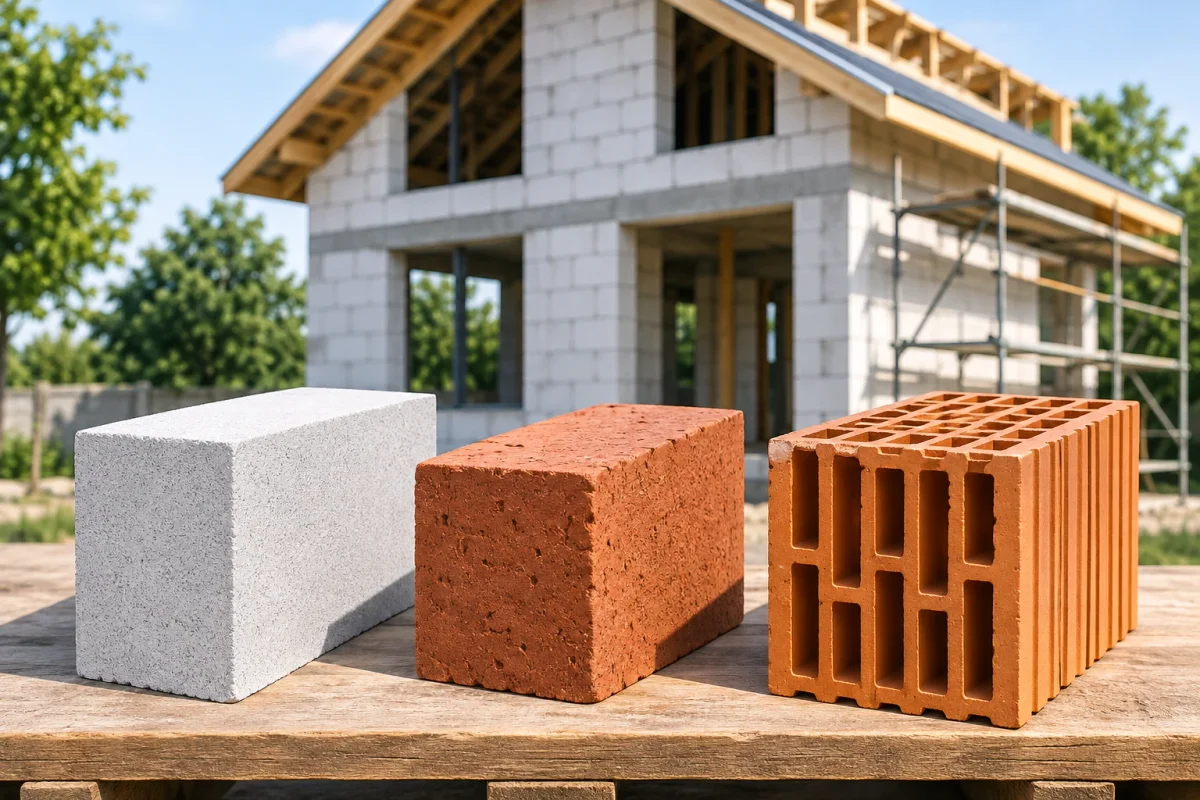
For private construction in Tashkent, aerated concrete is often chosen for its speed of installation and price. Brick appeals with its strength and appearance but costs more. Ceramic block is a middle ground: warmer than brick, stronger than aerated concrete. Market prices for materials in Tashkent at the end of 2023 (estimate) give this order: aerated concrete — from 450,000 to 650,000 soum per m³, ceramic brick — from 900,000 to 1,500,000 soum per 1,000 pieces, ceramic block — about 30–40% more expensive than aerated concrete per cubic meter. These figures are for rough estimation; actual prices depend on purchase volume. If you're comparing which material is more cost-effective, start with the total wall cost, not the price per cubic meter.
Pros and cons of aerated concrete and where it's truly advantageous
Aerated concrete is a porous concrete with advantages: lightness, low thermal conductivity (coefficient around 0.10–0.14 W/(m·K)), fast laying, and low weight, which reduces reinforcement and foundation costs. A house shell can be quickly built from aerated concrete, and due to precise geometry, insulation and finishing costs are reduced.
Disadvantages: lower mechanical strength (class B2–B3.5), tendency to crack during settlement, and moisture accumulation without finishing. Aerated concrete doesn't like prolonged contact with water (needs finishing or hydrophobic treatment). For reliability, a monolithic reinforced belt is placed under aerated concrete walls.
The question aerated concrete or brick – which is better for a house in Tashkent is often decided in favor of aerated concrete when the budget is limited and quick results are desired. If you need a warm house without insulation, aerated concrete 300–400 mm thick provides sufficient thermal resistance for the climate of the Tashkent region. Comparison of aerated concrete and brick by timeline: a crew completes the shell from aerated concrete in 3–4 weeks, while brick masonry for the same house takes 6–8 weeks. The comparison of aerated concrete and brick should also consider future facade maintenance.
Brick: when paying more is justified
Brick is a classic. Its advantages: high strength and frost resistance, good sound insulation, durability, and the ability to get a beautiful facade without finishing. A brick house is more resistant to precipitation and less demanding in maintenance.
However, brick is a heavy material. Its walls require a more robust foundation, and the thermal conductivity of brick (0.4–0.7 W/(m·K)) forces thicker masonry or additional wall insulation. Brick laying is labor-intensive, and installation speed is lower than aerated concrete.
Brick should be chosen if durability and aesthetics for decades are important, and the budget allows for a foundation with a margin. For the Tashkent climate, brick 510 mm thick with external insulation provides a comfortable home, but the estimate increases moderately. For walls, it's convenient to use ceramic brick that complies with SHNK, which specifies requirements for stone structures. When calculating which material is more cost-effective, remember the cost of brick walls: it's higher due to foundation and insulation.
Ceramic block: a compromise between price and warmth
Ceramic block is a hollow ceramic block with tongue-and-groove connection. It combines the strength of ceramic with lower weight and better thermal insulation due to air chambers. The thermal conductivity of ceramic block in masonry is approximately 0.15–0.25 W/(m·K), depending on thickness and density.
Ceramic block is quickly installed thanks to the tongue-and-groove design: no mortar in vertical joints. Strength is higher than aerated concrete (class B5 and above), which is important for load-bearing walls. Ceramic block is less demanding in finishing than aerated concrete.
Ceramic block price Tashkent: approximately from 1,200,000 to 1,800,000 soum per cubic meter (estimate for early 2024). It's more expensive than aerated concrete but cheaper than brick masonry of comparable thermal protection with a thinner wall. Ceramic block price Tashkent varies by 10–15% across suppliers depending on batch and volume. When comparing ceramic block or aerated concrete, keep in mind that ceramic block requires less insulation than brick. Request ceramic block price Tashkent from two or three suppliers at once and compare delivery terms.
Wall price, thermal conductivity, installation speed, service life
| Parameter | Aerated concrete | Brick | Ceramic block |
|---|---|---|---|
| Material price per m³/1,000 pcs | 450,000 – 650,000 soum/m³ | 900,000 – 1,500,000 soum/1,000 pcs | 1,200,000 – 1,800,000 soum/m³ |
| Thermal conductivity, W/(m·K) | 0.10 – 0.14 | 0.4 – 0.7 | 0.15 – 0.25 |
| Installation speed | High (adhesive laying) | Medium (mortar laying) | High (tongue-and-groove) |
| Service life | 50–70 years | 100+ years | 70–100 years |
| Foundation requirements | Low (light walls) | High (heavy walls) | Medium |
Construction in Tashkent follows a project, and design of an industrial workshop in Uzbekistan and residential buildings rely on the same load standards. If the plot is complex, study the material on foundation on collapsible soils in Uzbekistan: the soil type can change the choice of wall material. Also consider that the foundation for aerated concrete depends on the soil.
Seismicity and climate of Uzbekistan: what to consider when choosing a block
Tashkent is in a seismic zone, so walls must withstand horizontal loads. Aerated concrete is a brittle material; for seismic areas, it must be reinforced: monolithic belts, masonry reinforcement. Brick is stronger but more massive, increasing the load on the foundation. Ceramic block holds an intermediate position in strength and weight. When choosing material for walls in a seismic area, consider the need for reinforcement.
When choosing material for a house in Tashkent, seismic calculation is mandatory. Verification is done according to SHNK 2.01.03-19 "Construction in Seismic Regions." The project must specify concrete class, reinforcement, and connection details.
Climate: hot summers and cool winters. For aerated concrete and ceramic block, moisture protection is important: facade finishing is mandatory. Brick is less sensitive to moisture, but it's better to protect it too. Wall thickness, considering thermal engineering and seismicity, is usually 300–400 mm for aerated concrete, 380–440 mm for ceramic block, and 510–640 mm with insulation for brick.
How material affects wall thickness, foundation, and estimate
The thicker the wall, the more materials and labor. For example: a 100 m² house with 300 mm aerated concrete — masonry volume about 30 m³ (including windows and doors), at 550,000 soum/m³, the cost of wall materials is approximately 16,500,000 soum. A 510 mm brick wall will require about 40,000 bricks (at 1,200,000 soum/1,000 pcs — 48,000,000 soum). Ceramic block 380 mm — about 38 m³ at 1,500,000 soum = 57,000,000 soum. The difference in material costs is significant.
Foundation: for aerated concrete, a shallow strip foundation is sufficient; for brick, a more massive one. Savings on the foundation for aerated concrete can be up to 20–30% of the foundation cost. The estimate also includes finishing: aerated concrete requires plastering or cladding, brick can do without it if the masonry is face brick.
Ultimately, aerated concrete walls give the lowest shell cost but require investment in insulation and finishing. Brick is more expensive at the shell stage but can save on finishing and heating in the long run. Ceramic block is a reasonable balance, but the price is higher than aerated concrete. The price of a house project in Tashkent from private firms starts at 30,000–50,000 soum per m², and this expense pays off: the project determines wall thickness and insulation. Compare the full cost of walls with finishing before deciding which material is more cost-effective. The project price strongly depends on area and complexity: for a 100–120 m² house, expect about 3–6 million soum for a basic package.
What to do next: from estimate calculation to house project
To make a decision, order development of project documentation or do a preliminary calculation yourself. Compare the cost of 1 m² of finished wall (with insulation and finishing) for each option. Consider seismic requirements and soils. For a 2-acre plot in Tashkent, it's important to properly position the house and choose the structural design.
Professional architectural design services will help avoid mistakes. All loads and heat losses will be considered. monolithic or frame construction in Tashkent is a structural topic, but the choice of wall material is directly related. turnkey construction includes all stages: from design to finishing, with author supervision.
Author supervision in Uzbekistan helps keep the estimate in check: the project author inspects masonry and connections, preventing substitution of material with a cheaper one at the expense of strength. For the engineering part, study design of engineering systems in Uzbekistan: heating and ventilation are also included in the house budget. Thus, savings on heating are laid down at the design stage, not after moving in.
About ZeroMax Group performs full-cycle design and construction with author supervision. See our projects in Dubai and ZeroMax Group certificates, and for projects in Uzbekistan — warehouse construction in Uzbekistan and school design.
To order a calculation, contact us by phone +971585380110 or leave a request on ZeroMax Group contacts. If you need a contractor for the entire house, we'll discuss turnkey construction in Tashkent and select material for your budget. Turnkey construction in Tashkent with a fixed estimate eliminates the risk of material price increases mid-work.
Three mistakes that eat up wall savings
The price difference between aerated concrete and ceramic block for a 100 m² house can reach 20–30 million soum. But part of this savings is easily lost during construction. Here are three most common situations. If you're wondering which material is more cost-effective, don't repeat these mistakes.
| Client mistake | Risk | How to avoid |
|---|---|---|
| "I'll take cheaper aerated concrete, brand doesn't matter" | D400 block instead of D500 on a load-bearing wall gives a lower safety margin than calculated; cracks under floor slab loads | Use the brand specified in the project (usually D500–D600 for load-bearing walls) from a seller with a batch certificate |
| "I'll insulate later, save now" | A 300 mm wall without finishing loses heat in winter; with gas heating, the extra cost per season can be 1.5–2.5 million soum | Calculate the wall as a system: block + insulation + finishing per 1 m², not just the block price |
| "I'll lay on regular cement mortar, it's cheaper" | Cold bridges in 10–15 mm joints instead of 2–3 mm adhesive; heat loss increases by 15–25% | For aerated concrete and ceramic block — use adhesive or warm mortar; cement only for brick and leveling |
Separately about masonry in hot weather. Aerated concrete absorbs water like a sponge: if you don't wet the block before laying at temperatures above 30 °C, the adhesive sets unevenly, and the joint loses strength. In summer in Tashkent, masonry is done in the morning or evening, and the finished wall is kept under film or periodically sprayed with water for the first 2–3 days. Calculate heating costs over 10 years together with masonry quality: cold bridges eat up all the savings.
Block acceptance checks: what to look at before payment
The batch is delivered to the site, and unloading should be done with inspection. Five simple steps take 15–20 minutes and eliminate most disputes with the supplier.
- Check geometry: open 5–6 blocks from different pallets, measure length, height, and thickness with a tape measure. Deviation over 2–3 mm for aerated concrete and 1–2 mm for ceramic block complicates even masonry.
- Look at chips and corners. Small chips on edges up to 10–15 mm are acceptable; cracks through the entire block are defects.
- Ask for the batch certificate: it shows density grade, strength class, production date, and manufacturer. Aerated concrete needs to "cure" for 2–3 weeks after autoclaving, otherwise it will shrink in the masonry.
- Drop a block from about a meter onto a hard surface. Aerated concrete breaks into pieces; ceramic block usually remains intact or has limited chipping. This shows the material's brittleness and helps estimate how much breakage to account for in the purchase.
- Weigh one block. A mass 10% or more below the declared value is suspicious: either the block is under-dried or the density is lower than specified.
Factor in waste and offcuts when you order materials: add 3–5% to the volume for aerated concrete blocks, 5–7% for ceramic blocks, and 5–8% for brick when you have complex masonry with corners and bay windows. A house project price in Tashkent usually includes a materials specification where these allowances are already factored in. If you're unsure about a supplier, compare the price of ceramic blocks and aerated block prices in Tashkent in a single request—that way you see the real difference.
Frequently asked questions
Which material is cheaper during the shell construction phase, and which is cheaper during the heating phase?
During the shell phase, aerated concrete is the cheapest: lightweight walls and fast installation reduce foundation and labor costs. During the heating phase, aerated concrete or ceramic blocks win: their low thermal conductivity cuts heating costs in winter and air conditioning costs in summer. Brick requires more energy for heating due to its high thermal conductivity, unless the walls are insulated.
Can aerated concrete withstand seismic loads in Tashkent, and how is this verified?
Aerated concrete withstands seismic loads provided the masonry is reinforced and monolithic belts are installed. Verification is carried out according to SHNK 2.01.03-19: the design calculates horizontal loads and selects the concrete class and reinforcement. Using aerated concrete in a seismically active area without a proper design is risky.
Is insulation needed if the walls are made of ceramic blocks or aerated concrete?
For aerated concrete 300–400 mm thick in Tashkent's climate, additional insulation is often unnecessary; exterior finishing is enough to protect against moisture. Ceramic blocks 380–440 mm also provide sufficient thermal resistance. Insulation is needed if the walls are thinner or if energy efficiency requirements are higher.
How much more expensive is a brick house, and what drives up the estimate?
A brick house is about 20–30% more expensive than an aerated concrete one in terms of wall materials and foundation costs. The estimate grows due to the greater weight of the walls (requiring a stronger foundation), the labor intensity of the masonry, and the need for insulation to achieve the same heat loss as aerated concrete. As a rough guide, brick walls will cost 2–3 times more than aerated concrete walls, excluding finishing.
How to choose a material for a house project on a 2-sotka plot in Tashkent?
On a 2-sotka (200 m²) plot, it's important to position the house correctly and choose a structural design that accounts for the soil conditions. Start with a geological survey and a design. If the budget is limited, choose aerated concrete. If durability and status are important, consider brick. Ceramic blocks are a compromise option with good thermal performance.
What should you consider when choosing a material for a house in Tashkent?
Take into account seismic activity, soil conditions, climate, and budget. Be sure to order a design with heat loss calculations and structural details. Don't focus only on the material price: what matters is the cost of the finished wall including finishing and insulation, as well as future heating costs.
Can you save money by using combined solutions?
Yes, for example, load-bearing walls made of aerated concrete with brick cladding. This gives you the strength and appearance of brick at a lower weight and cost. Or ceramic blocks with minimal finishing. Combined options allow you to optimize the estimate but require a competent design. The question "which material is more cost-effective for building a house" is answered by considering the combination of materials.
House construction in Tashkent most often starts with aerated concrete as the cheapest structural material, while ceramic blocks and brick are chosen when warmth and durability are the priority. Calculate the cost per 1 m² of finished wall for each option and compare it with your budget. ZeroMax Group will measure your plot, prepare an estimate and a design for your chosen material.