Monolithic vs. Steel Frame: Which to Choose for a Commercial Building in Tashkent

The decision to build a commercial facility using monolithic reinforced concrete or a steel frame is made right at the start. It shapes the structural design, the budget, the schedule, and how the building will hold up over the years. Almost every client — from developers to manufacturing owners — asks the question "monolithic or frame construction in Tashkent," and there's no one-size-fits-all answer. There's a set of factors that need to be weighed for your specific project.
In this article, we'll look at how the two technologies differ across key parameters, how Tashkent's seismic conditions come into play, and what to consider when choosing a contractor.
What Is a Monolithic Frame and a Steel Frame
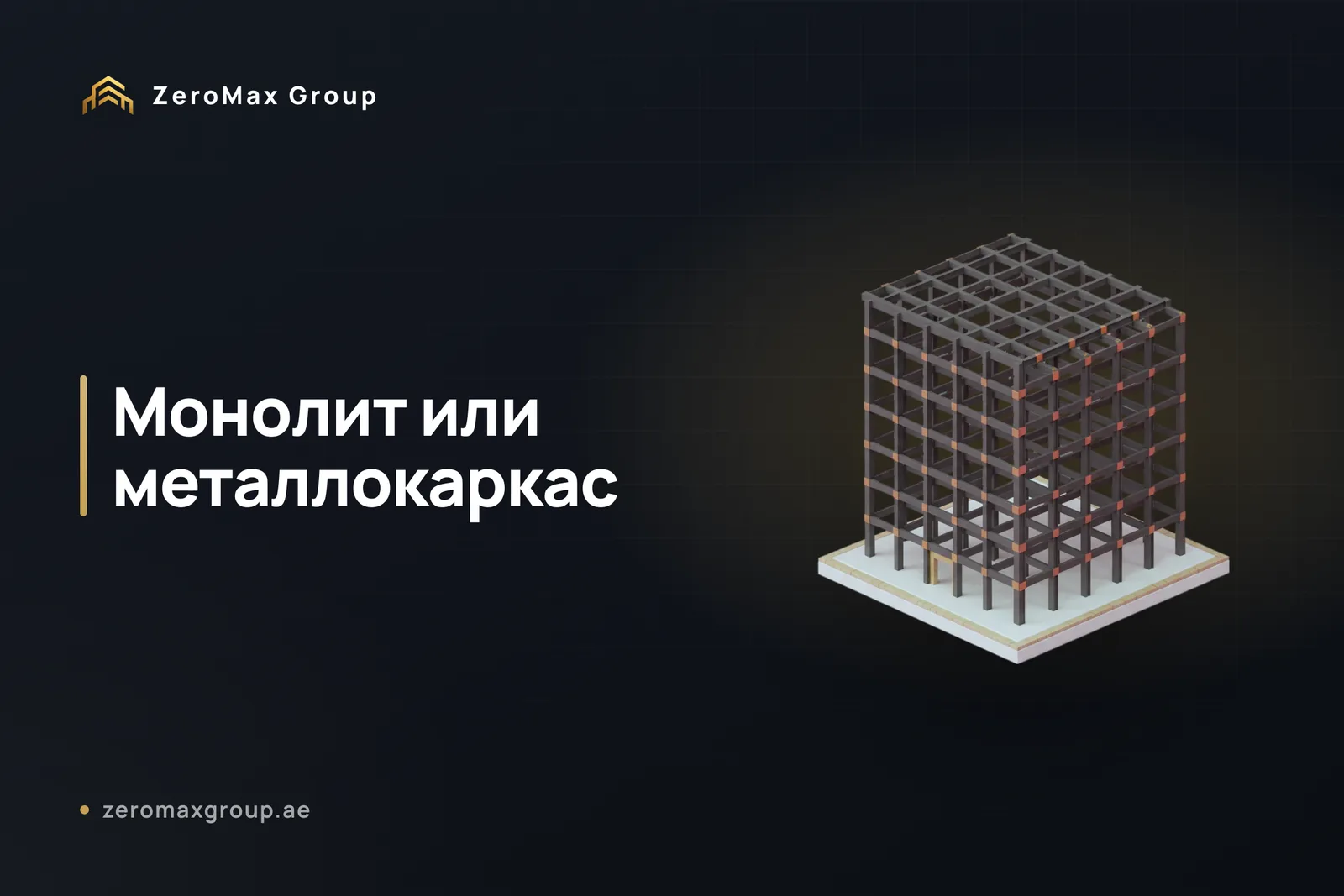
A monolithic frame is a spatial system of columns, walls, and floor slabs cast in place using formwork. Rebar ties the elements together into a single rigid frame. A steel frame is assembled from factory-made steel beams and columns, erected on site using bolted or welded connections.
Both technologies are load-bearing. Both can serve as the backbone of a shopping center, business center, hotel, manufacturing plant, or logistics complex. The difference lies in how they perform under load, what they cost under specific conditions, and how fast they go up.
A designer doesn't pick a "favorite" technology — they pick the one that delivers the best balance of strength, timeline, and cost for a specific site, purpose, and client budget.
How Tashkent's Seismic Activity Affects Frame Choice
Tashkent is a seismically active zone. This isn't an abstract concern — it's a design load that both concrete and steel must account for. Building codes set requirements for stiffness, bracing, and connections, and both materials can meet them — with the right engineering.
Monolithic construction has greater mass, which is both an advantage and a drawback. The upside is inertia and structural integrity; the downside is that seismic loads grow with weight. A steel frame is lighter but requires well-designed bracing and connections to ensure spatial rigidity.
The key is engineering to current codes, not going on gut feeling. For more on requirements and real-world practice, see our article on seismic-resistant construction in Tashkent.
What to consider for seismic performance:
- The design model and the building's importance class.
- Connection stiffness and the presence of bracing.
- The type of foundation required for the chosen frame.
Construction Speed and Project Timeline
A steel frame is usually faster: components are fabricated at the plant while foundation work proceeds on site, and erection takes less time than casting concrete. For projects that need to start generating revenue quickly, that's a significant edge.
Monolithic construction takes time for formwork, rebar, pouring, and curing. On the other hand, the structure comes out seamless — no joints or bolted connections — and finishing work can start earlier in some areas.
In practice, the timeline depends not just on the technology but on work organization, material availability, and how well the contractor coordinates. Sometimes a steel frame only saves time if the plant, roofing, and facade are all delivered on schedule.
Cost and the Impact of Logistics in Uzbekistan
Comparing technologies by "price per ton or per cubic meter" doesn't work. The final cost is a mix of materials, labor, foundation, finishing, and operation. In Uzbekistan, logistics plays a major role: steel products are often imported, while cement, aggregates, and rebar are mostly local.
Monolithic construction may be cheaper on materials but more expensive in terms of time and labor intensity. A steel frame goes up faster but requires steel, corrosion protection, and fireproofing. All of this needs to be calculated as a whole.
Our experience shows: cutting corners at the frame-selection stage without considering long-term operation ends up costing more. Take a look at our completed projects — you can see how different technologies perform in practice.
Service Life, Fire Resistance, and Maintenance
Reinforced concrete is inert to corrosion, holds up well against fire, and needs no additional protection. Steel must be protected against corrosion and fire — otherwise it loses load-bearing capacity in a fire and rusts in damp environments.
On the other hand, a steel frame is easier to dismantle, reconfigure, or reinforce during renovation. For industrial facilities where layout changes are likely, that's a plus.
Operating costs differ too. Concrete doesn't need painting but is harder to reinforce. Steel requires periodic inspection and renewal of protective coatings.
Comparing Technologies by Key Parameters
To keep things clear, let's summarize the main differences in a table. It'll help you quickly assess what matters most for your project.
| Parameter | Monolithic Frame | Steel Frame |
|---|---|---|
| Construction speed | Moderate, depends on curing time | High with prefabricated components |
| Seismic resistance | Achieved through engineering and stiffness | Achieved through bracing and connections |
| Fire resistance | High without additional protection | Requires fireproofing |
| Corrosion resistance | High | Requires anti-corrosion protection |
| Layout flexibility | Lower | Higher |
| Dependence on logistics | Mostly local materials | Often imported steel |
The table doesn't give you a ready-made answer — it shows what questions to ask your designer and cost estimator.
When to Choose Monolithic
Monolithic makes sense when you need maximum fire resistance and durability without additional protective layers. For example, for high-rise residential complexes, healthcare, and educational facilities where sanitary and fire safety requirements are strict.
Monolithic is also the logical choice for complex architectural forms that call for sculptural shapes and seamless surfaces. If the region has stable supplies of cement and rebar and the timeline isn't critical, this technology often wins on total cost.
When to Choose a Steel Frame
A steel frame is the go-to when speed matters and you need to span large openings quickly. It's ideal for manufacturing plants, warehouses, hangars, retail pavilions, and projects that must be commissioned on a tight schedule.
It also works well for vertical additions and renovations: a lightweight frame doesn't overload existing foundations. If the facility may need future reconfiguration, steel offers more freedom.
Hybrid Solutions and Combined Frames
In practice, a combination is often used: monolithic core and steel floor slabs, or vice versa. This approach lets you take the best of both technologies and optimize timeline and cost.
A hybrid is more complex to design and requires coordinated work between structural engineers, technologists, and erectors. But it often delivers the optimal result for large and unconventional projects.
How to Choose a Contractor for Your Project
Choosing the technology is only part of the job. Who implements it matters just as much. Look for a contractor with experience in your specific type of facility, an in-house design team, and transparent pricing.
Request estimates for both frame options, review completed projects, and clarify who handles design supervision. That way you'll reduce risks and get a predictable outcome.
At ZeroMax Group, we design and build commercial facilities in Tashkent and across Uzbekistan — from architecture to turnkey delivery. If you need an honest technical and economic analysis, get in touch — we'll discuss your project and find a solution that fits your goals and budget.
Comparing Timeline, Cost, and Logistics for Tashkent's Conditions
Once a project is tied to a specific site, the technology debate quickly moves from generalities to two things: how much it costs and how fast you can get the facility operational. That's where monolithic and steel behave differently, and the gap is especially noticeable in Tashkent.
Construction speed. A steel frame wins at the erection stage: beams and columns arrive from the plant, ready to assemble. But that advantage only holds with a well-oiled supply chain. If steel is shipped from far away and the fabrication drawings get revised on the fly, the time savings evaporate. Monolithic is slower per cycle — formwork, rebar, pouring, curing — but more predictable schedule-wise when rebar and concrete are sourced locally.
Cost. Comparing the price per ton of steel and per cubic meter of concrete is pointless. You need to calculate the full frame cost: foundation, the structure itself, fireproofing, connections, erection. A lightweight steel frame lets you save on the foundation — often a decisive argument on weak soils. Monolithic has a higher frame cost but lower spending on fireproofing and facade finishing, because concrete handles some of those functions on its own.
Logistics in Tashkent. Concrete is a perishable product — it's hauled from the nearest batching plant within a reasonable delivery radius. Steel can be ordered from anywhere, but then transport adds to the cost and waiting adds to the timeline. For a densely built city, that means: tight sites, crane and mixer-truck access restrictions, noise and dust during concrete pouring. A steel frame is gentler on the neighbors in that sense — erection is faster and cleaner.
Seasonality is another factor. In winter, concrete work requires heating and anti-freeze admixtures; in summer, it needs curing in the heat. Steel can be erected in almost any weather, as long as welding and anti-corrosion procedures are followed.
| Parameter | Monolithic Reinforced Concrete | Steel Frame |
|---|---|---|
| Frame erection speed | Lower, cyclical process | Higher with prefabricated components |
| Sensitivity to logistics | Depends on local batching plants | Depends on the plant and steel delivery |
| Fire protection | Provided by the material itself | Requires additional measures |
| Repair and reconfiguration | Harder, requires demolition | Easier thanks to bolted connections |
| Clear spans | More limited | Can be wider |
When Monolithic, When Steel Frame: Practical Scenarios
The choice usually becomes clear once the project is matched to a specific task. An abstract "which is better" doesn't work here — what works is aligning with the building's purpose, soil conditions, and budget.
Monolithic makes sense if:
- the building is multi-story and needs maximum rigidity and structural integrity;
- high fire resistance is important without extra protection costs;
- underground floors and parking are planned — monolithic is more convenient for below-grade structures;
- there's access to quality concrete and rebar, and the crew knows how to work with formwork;
- the facility is designed to last decades without major reconfiguration.
A steel frame is justified when:
- large spans without intermediate supports are needed — warehouses, hangars, retail galleries, sports complexes;
- speed matters and the project must be delivered on a tight deadline;
- soils are weak and a lighter frame reduces the load on the foundation;
- future expansion or reconfiguration is planned — bolted connections make that possible;
- construction happens on a cramped site where there's no room for a concrete operation.
There's also a hybrid approach that often turns out to be the smartest: monolithic core and underground portion plus steel floor slabs or roof structures. This gives you concrete's rigidity for critical zones and steel's lightness for large spans. You'll see this solution in Tashkent's business centers and hotels, where both qualities are needed.
Bottom line? There's no technology that's "better overall." There's a technology that better fits your site, purpose, schedule, and money. Monolithic delivers mass, fire resistance, and a proven local supply base. Steel delivers speed, spans, and flexibility. Before choosing, it's worth pricing out both options at least at the concept level — that's cheaper than changing course mid-construction.
Construction Cost: What Goes into the Price of Monolithic and Steel Frame
When a client asks "which is cheaper," they usually mean the turnkey price per square meter. But the numbers depend heavily on what you're actually counting. Let's break it down to see where the money goes fastest.
Monolithic means formwork, rebar, concrete, the labor of concrete workers, and time. Each floor "grows" slowly. But materials are readily available, and concrete suppliers in Tashkent operate reliably.
A steel frame means factory-made structures delivered to site ready to go. Erection is fast, but the steel itself and its processing cost more. Plus logistics: if steel is shipped from far away, transport adds to the price.
| Cost item | Monolithic | Steel Frame |
|---|---|---|
| Primary material | Concrete, rebar — available locally | Structural steel, often imported |
| On-site labor | High: formwork, tying, pouring | Lower: assembly from prefabricated elements |
| Construction speed | Slower, depends on curing time | Faster, year-round erection |
| Foundation | Heavier due to building weight | Lighter, potential savings |
| Finishing and MEP | More flexible: chases, embedded items | Requires advance planning |
In practice, monolithic often wins on large floor plates with simple geometry. A steel frame becomes more cost-effective when schedule is critical, when soils are weak, or when the building needs to be operational quickly. Sometimes you're not counting money — you're counting months: every month of delay means lost rent or postponed production.
Timelines, Logistics, and Seasonality: What Matters in Tashkent
Tashkent's climate allows year-round construction, but each technology has its own limitations. Concrete doesn't handle heat above +35°C well without special measures: it sets too quickly, and cracks appear. In winter, when temperatures drop below freezing, you need antifreeze admixtures or heating. This adds hassle and expense.
Steel is simpler in this respect. It can be installed in both heat and cold, as long as you follow proper welding and bolting procedures. But there's a catch: in Tashkent, metal in the summer sun gets so hot that working with it without protection is tough. You have to shift the schedule to morning or evening.
Logistics also plays a role. Concrete must be poured continuously, so the plant needs to be nearby. If it's in another district, every truck stuck in traffic is a risk of a cold joint. Steel frames are delivered from the factory in complete batches, and here it's important that the site can accommodate long-bed trucks and cranes.
Another factor is the rainy season. In spring and autumn, Tashkent gets prolonged downpours. A monolithic slab turns into mud, and equipment gets bogged down. Metal structures can be stored under a canopy and installed in the "windows" between rains.
If the project is tied to a specific opening date, a steel frame offers more predictability. If timelines are flexible and the budget is tight, cast-in-place concrete lets you spread financing across stages.
Timelines and Logistics: What Really Speeds Up Construction in Tashkent
When a client asks about timelines, they usually mean the speed of assembling the structural frame. That's a trap. A steel frame does go up faster than cast-in-place concrete—on average 30–40% faster for the frame. But the overall project duration depends on what happens before and after.
Cast-in-place concrete ties construction to the site from day one. You need formwork, rebar, concrete pumps, and workers experienced in tying and pouring. Each floor is a cycle: set formwork, tie rebar, pour, cure, strip. In hot weather, concrete gains strength differently than in spring, and in Tashkent summers, pouring is often moved to night or early morning—otherwise the mix sets too quickly and the risk of cracking increases. Winter is a different story: heating, antifreeze admixtures, temperature control. All this stretches the schedule and adds line items to the estimate that might not be in a standard calculation.
A steel frame shifts most of the work to the factory. Columns, beams, and braces are cut, drilled, and painted in the shop—regardless of weather, without dependence on precipitation or temperature on site. Finished elements arrive at the site, and all that's left is to lift and secure them. Installation goes on year-round, and in Tashkent's climate that's a tangible advantage.
But there's a catch that surfaces on real projects. Steel frames are critically dependent on delivery schedules. A one-week delay in steel delivery stops installation entirely—there's no substitute, and no buffer on site. Cast-in-place concrete has a more "forgiving" rhythm: if rebar doesn't arrive today, it might come tomorrow, and some work can be rearranged. However, concrete can't be accelerated indefinitely—it gains strength according to physics, not the foreman's wishes.
Another point rarely discussed when choosing a frame is intra-city logistics. Tashkent isn't made of rubber. Oversized metal structures are trucked from the factory through city streets, and route approvals, delivery times, and unloading at a cramped site are all real constraints. Cast-in-place work, on the other hand, requires a steady supply of concrete: if a mixer gets stuck in traffic, the mix arrives with the wrong consistency. In both cases, the contractor with well-established supply chains wins, not the one promising "the fastest timelines."
| Parameter | Cast-in-place Concrete | Steel Frame |
|---|---|---|
| Frame speed | Cyclical, depends on concrete strength gain | Faster due to factory-ready elements |
| Seasonality | Yes: heat and cold require special measures | Minimal: installation year-round |
| Sensitivity to supplies | Concrete and rebar, but some room for maneuver | High: steel delay halts installation |
| Transport constraints | Mixers and concrete pumps | Oversized structures, route approvals |
Operation and Future of the Building: What's Cheaper to Maintain and Easier to Renovate
Choosing a frame isn't just about construction. It's about the years the building will serve after handover. And here cast-in-place concrete and steel diverge in character.
Cast-in-place concrete behaves predictably and boringly—in a good way. It doesn't fear moisture, doesn't require anti-corrosion protection, and doesn't need periodic painting. If everything is poured and designed correctly, repairs to load-bearing elements may not be needed for decades. This noticeably reduces operating costs—the owner doesn't budget for regular inspections of connections and touching up steel.
Steel frames require attention. Steel corrodes, and protective coatings need renewal. Hidden connections covered by cladding or concrete are hard to inspect—you have to rely on the quality of initial treatment and adherence to technology. In humid summers and temperature swings, coatings age faster than you'd like. Fire protection also needs maintenance: intumescent coatings have a service life and must be reapplied. All these are expense items that cast-in-place concrete doesn't have.
But steel frames offer flexibility that concrete can't. Need to remove a column, increase a span, create an opening for new equipment, or add a floor—steel makes it easier. Bolted connections can be disassembled, elements replaced, and the structure reinforced without major reconstruction. For a commercial building that will see several tenants and possibly change purpose over decades, that's a strong argument.
With cast-in-place concrete, that's not possible. Moving a load-bearing wall or widening an opening means cutting reinforced concrete, reinforcing, recalculating. Sometimes it's easier to abandon the idea than to get involved. Tenant asks for an open layout without columns in the center of the hall? If the concrete is already poured, the answer is no.
There's also a less obvious point—acoustics and vibrations. Steel frames are more resonant, and in buildings with sensitive equipment or specific noise requirements, this must be mitigated with additional solutions. Cast-in-place concrete, thanks to its mass, dampens vibrations naturally. For a manufacturing facility or laboratory, this can be a decisive factor that comes up during finishing.
Ultimately, the logic is simple: if the building is built for the long haul for a single function and you want minimal operational hassle, cast-in-place concrete is more predictable. If renovations, tenant changes, or expanding floor areas are planned, a steel frame leaves room for maneuver. Both options work; the question is which scenario fits your project better.
How to Calculate Cost Honestly, Not Just by Price per Square Meter
The price per square meter of the frame, often quoted during selection, means almost nothing. It doesn't account for the foundation, MEP systems, finishes, fire protection, anti-corrosion measures, and operating costs for years ahead. The real cost of ownership is made up of several layers, and they are distributed differently between cast-in-place concrete and steel.
Cast-in-place concrete has higher direct costs for materials and labor: concrete, rebar, formwork, work. But fewer hidden items—no fireproofing, anti-corrosion treatment, or regular maintenance of connections. With a steel frame, the shell may come out cheaper and faster, but you add fire protection, corrosion protection, coating maintenance, and sometimes reinforced foundations under certain nodes. Over time, these costs accumulate.
To compare fairly, you must look at total cost of ownership over the service life—say, 20–30 years—not the initial estimate. Otherwise, the choice is based on a number that doesn't reflect reality. The client saves upfront and overpays later, or vice versa.
Separately, you should account for risks that are real in Tashkent: seismic requirements may demand reinforcement of either frame, which changes the estimate. Soil conditions on the site also play a role—sometimes the foundation for heavy cast-in-place concrete costs more than for lightweight steel, and that outweighs the difference in the frame. All this is calculated by the designer for a specific site, not taken from general tables.
Practical takeaway: before comparing money, define the building's operating scenario for 10–20 years ahead. If it's clear and stable, calculate with minimal maintenance in mind. If you anticipate changes, treat the flexibility of a steel frame as a separate value, not an extravagance. And demand a calculation from the contractor, not a ballpark price per meter.