
Pile Load Testing in Dubai
Pile load testing in Dubai: static compression, tension and lateral tests, dynamic testing and integrity checks of bored piles, with reports and conclusions.
- 10+
- Years of experience
- 15
- Specialists
- 6
- Disciplines
- 90+
- Projects
Types of pile tests
The programme usually combines load tests on a few piles with integrity checks on many.
- 01Static compression load tests
- 02Static tension and lateral load tests
- 03Dynamic load testing with a drop weight
- 04Low-strain integrity testing of bored piles
- 05Cross-hole sonic logging for large-diameter piles
- 06Preliminary pile tests before the foundation design is finalised
When pile load testing is needed
Pile tests are a normal requirement for piled foundations in Dubai, and the project specification and authority approvals usually set the type and number of tests. Preliminary tests are most valuable on large projects, where confirmed capacity can allow shorter or fewer piles and save more than the test costs.
Working pile tests and integrity checks confirm that the piles as built match the design. They are also used when something went wrong during construction, such as a collapse of the bore, an interruption in concreting or doubts about concrete quality.
How a static load test works
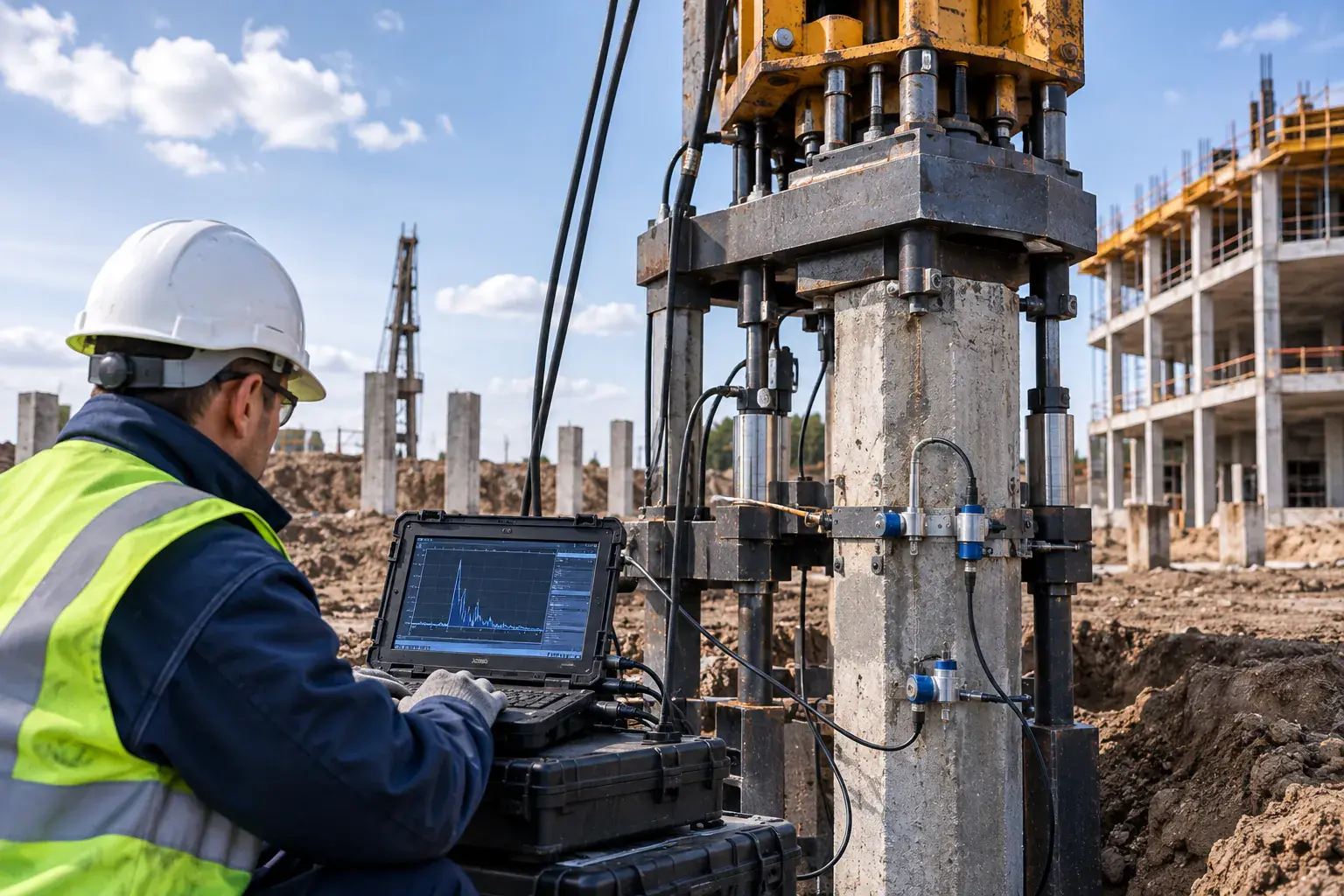
A reaction system is set up over the test pile: kentledge, a frame anchored to reaction piles, or ground anchors. The load is applied by hydraulic jacks in stages, usually beyond the design working load, and held at each stage while settlement is measured with dial gauges or electronic sensors referenced to an independent beam.
After the maximum load, the pile is unloaded in stages and the rebound is recorded. The resulting load-settlement curve shows how the pile behaves at working load and how much reserve it has.
Piled foundations in Dubai
Most piles in Dubai are bored cast-in-place piles socketed into weak sandstone or siltstone under the sand. Their capacity depends heavily on the quality of the rock socket and the base cleaning, which is why load tests and integrity tests matter so much here.
High saline groundwater adds another factor: piles are cast under water or support fluid, and the concrete must suit an aggressive environment. Integrity testing helps detect necking, inclusions or poor concrete at depth, which cannot be seen from the surface.
What you receive
The report gives everything the designer and the approval reviewer need.
- Test programme and pile location plan
- Loading records and load-settlement graphs
- Measured capacity and behaviour of each tested pile
- Integrity test results and any anomalies found
- Conclusions and recommendations for the foundation design
How we run a project
A clear route from the first meeting to handover of the finished building.
- 1
Consultation & site assessment
We discuss the brief, budget and constraints, then survey and measure the site.
- 2
Architectural design
We develop the concept and a full set of project documentation.
- 3
Approvals & permits
We clear the government approvals and obtain the required permits.
- 4
Estimate & planning
We prepare a detailed cost estimate, a work schedule and a delivery plan.
- 5
Construction & handover
We build and supervise on site, then hand over the finished building with full documentation.
Questions and answers
Short answers to the questions clients ask most often before a project starts. If yours is not here, write to us and we will advise on your project.
What is the difference between static and dynamic testing?
A static test applies load directly and measures settlement, which is the most reliable method. A dynamic test uses an impact and is faster and cheaper, so more piles can be checked.
Can existing piles be checked?
Yes. Integrity tests can be carried out on exposed pile heads, and a load test can be done on a working pile if the design allows it.
How many piles need to be tested?
The number is set by the specification and authority requirements, and depends on the total number of piles, ground conditions and the importance of the structure.
Does the site have to stop during testing?
No. The test area is fenced off, and other works continue around it in the agreed sequence.
Every remarkable project begins with a first step
From concept to delivery — we create architecture that unites aesthetics, function and engineering precision.