
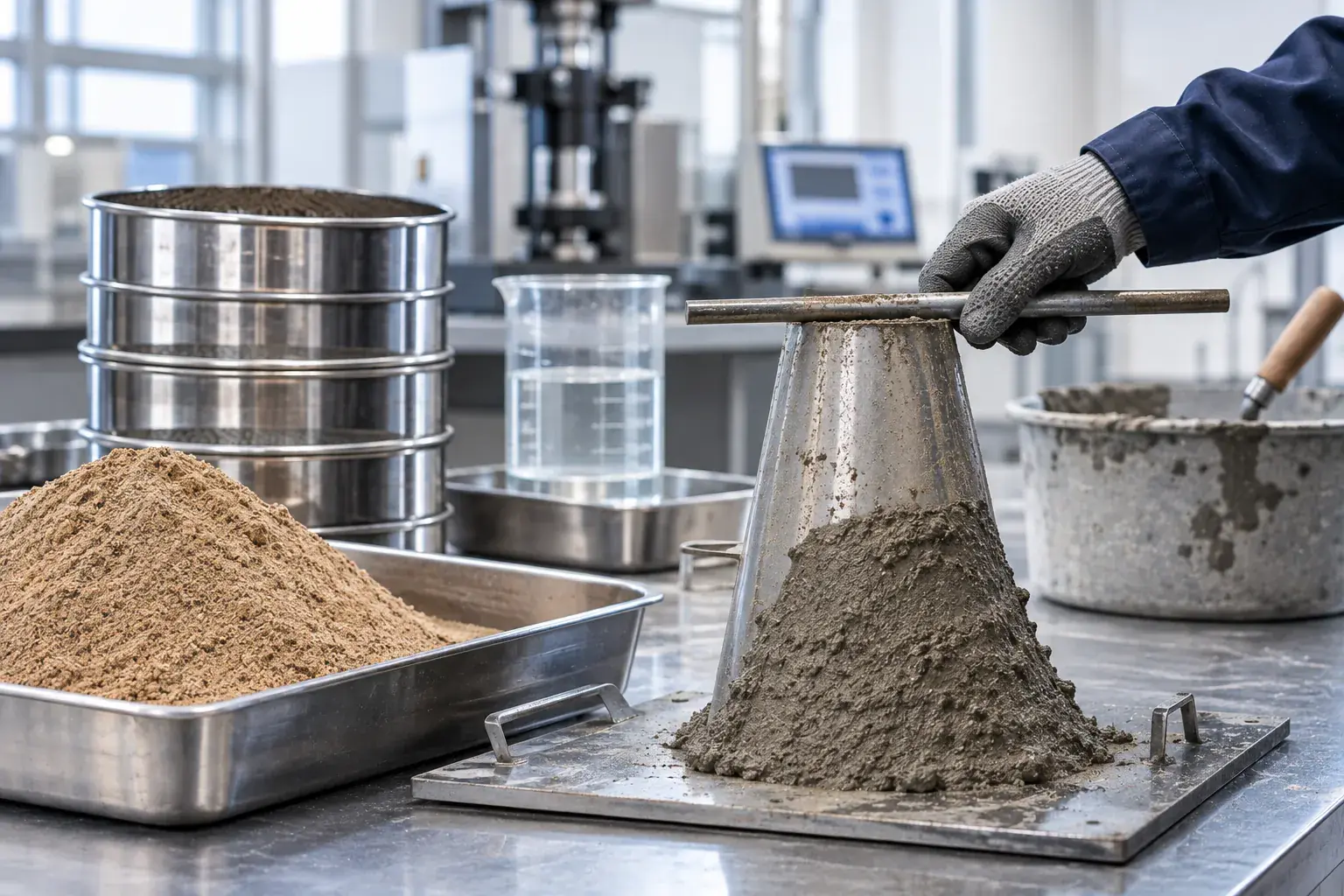
Mortar and Sand Testing in Dubai
Mortar and sand testing in Dubai: grading, fines and chloride and sulphate content of sand, mortar strength and bond, and checks of mortar in existing walls.
- 10+
- Years of experience
- 15
- Specialists
- 6
- Disciplines
- 90+
- Projects
What is tested in sand
Sand is tested to the applicable British or ASTM standards specified for the project.
- 01Particle size distribution and fineness
- 02Content of fines, silt and clay
- 03Clay lumps, shells and organic impurities
- 04Chloride and sulphate content
- 05Bulk density and moisture content at delivery
Important properties of mortar
For mortar, both the fresh mix and the hardened material are checked.
- Consistence and workability of the fresh mix
- Water retention
- Density
- Compressive strength and actual mortar class
- Bond strength of render and plaster to the substrate
When mortar and sand testing is needed
On new projects, sand and mortar are tested when a supplier or source is approved, when the source changes, and periodically during the works. Testing is also useful when render cracks or comes away, when white salt deposits appear on walls, or when screeds dust and crumble.
On existing buildings, mortar samples are taken from the joints of load-bearing walls before remodelling, an additional floor or new openings. Together with block testing, this gives the actual strength of the masonry for check calculations.
Dubai conditions
Salt is the main concern. Sand from coastal or sabkha sources, or sand that has not been properly washed, can contain chlorides and sulphates. In mortar and plaster this causes efflorescence and loss of bond, and in screeds and concrete it can start corrosion of embedded steel. Dune sand is very fine and uniform, so it is normally blended, and its grading must be checked to avoid weak, shrinkage-prone mortar.
Heat adds another problem: mortar and render dry too quickly on hot walls and in wind. Mixes with good water retention and proper curing reduce cracking, and testing confirms that the mix used on site matches the approved one.
Results and timing
You receive a report with results for each sample, comparison with the specification and recommendations: accept the material, adjust the mix or change the source. Sand tests are relatively quick; mortar strength tests take longer because specimens must cure before testing. Cost depends on the number of samples and tests required.
How we run a project
A clear route from the first meeting to handover of the finished building.
- 1
Consultation & site assessment
We discuss the brief, budget and constraints, then survey and measure the site.
- 2
Architectural design
We develop the concept and a full set of project documentation.
- 3
Approvals & permits
We clear the government approvals and obtain the required permits.
- 4
Estimate & planning
We prepare a detailed cost estimate, a work schedule and a delivery plan.
- 5
Construction & handover
We build and supervise on site, then hand over the finished building with full documentation.
Questions and answers
Short answers to the questions clients ask most often before a project starts. If yours is not here, write to us and we will advise on your project.
Can mortar be tested in old masonry?
Yes. Samples are taken from the joints at selected locations, and the strength and composition are determined in the laboratory.
Does sand need testing if I use pre-mixed mortar?
The manufacturer controls the sand in factory-made mortar. Testing is still useful to confirm the strength and bond of the mortar as used on site.
Why is salt in sand a problem?
Chlorides and sulphates cause efflorescence, weaken the bond of plaster and render, and can corrode steel in screeds and concrete.
How many samples are needed?
It depends on the volume of material and the specification. We agree the sampling plan before the work starts.
Every remarkable project begins with a first step
From concept to delivery — we create architecture that unites aesthetics, function and engineering precision.