
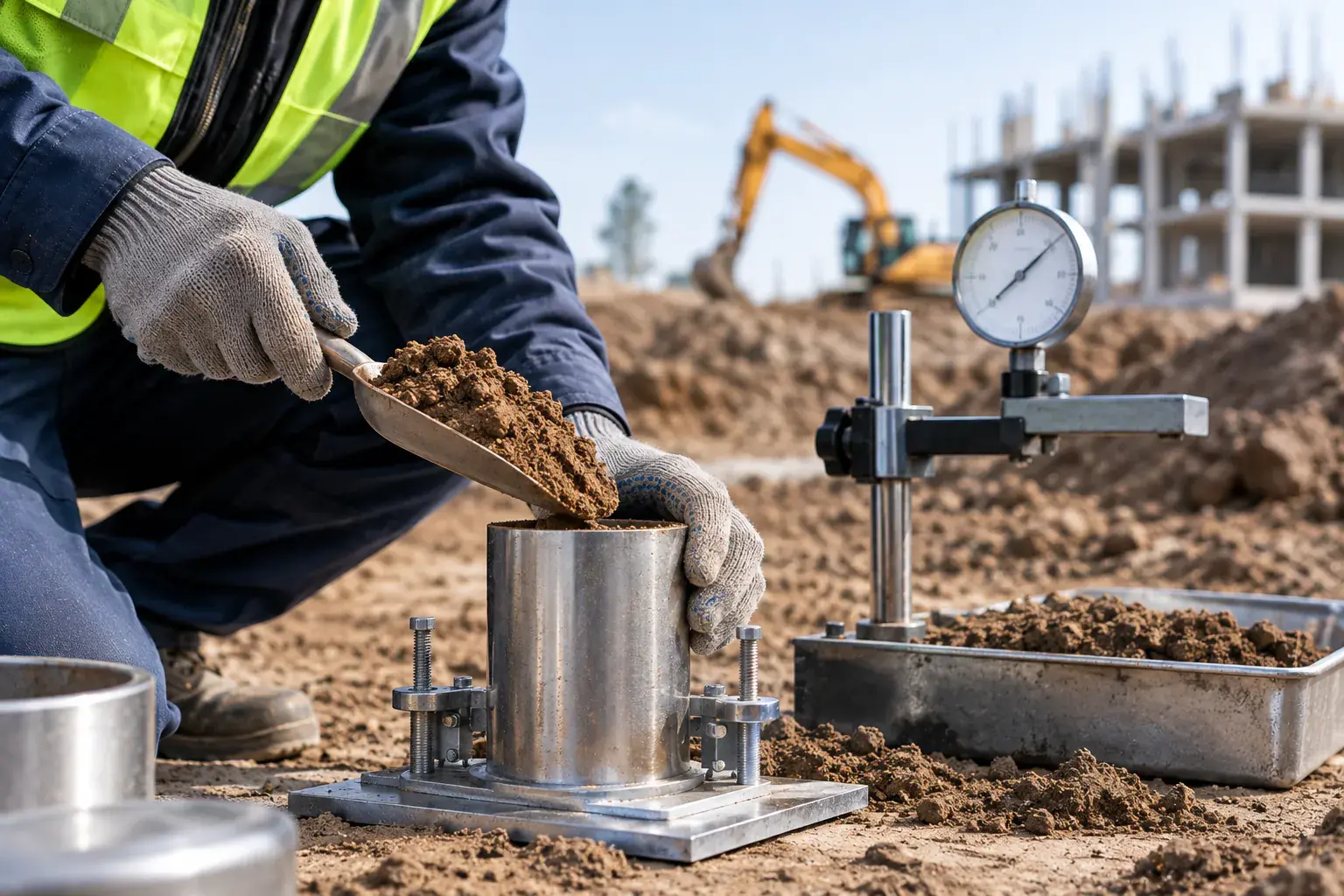
Soil Testing in Dubai
Soil testing in Dubai: laboratory classification, strength and compressibility, soil and groundwater chemistry, and compaction control of fill.
- 10+
- Years of experience
- 15
- Specialists
- 6
- Disciplines
- 90+
- Projects
What the laboratory determines
Samples from boreholes, trial pits or the fill being placed are tested to the applicable British or ASTM standards specified for the project.
- 01Particle size distribution and soil classification
- 02Natural moisture content and density
- 03Plasticity of fine-grained soils
- 04Shear strength and compressibility
- 05Maximum dry density and optimum moisture for compaction
- 06Chloride, sulphate and pH of soil and groundwater
Dubai ground conditions
Most of Dubai sits on sands of varying density, often over weak calcareous sandstone or siltstone, with sabkha in low-lying coastal and inland areas and reclaimed ground along the waterfront. Groundwater is often shallow near the coast and highly saline.
This makes the chemistry of soil and groundwater as important as strength. High chloride and sulphate contents decide the cement type, concrete grade, cover and waterproofing for the foundations. Loose sands and sabkha also raise questions of settlement and, in some cases, collapse on wetting, which the tests help to quantify.
Compaction control of fill and backfill
Much of the ground beneath slabs, paving and around foundations in Dubai is imported or reworked fill. If it is not compacted properly, slabs on grade crack, paving sinks and boundary walls tilt. Compaction control combines laboratory tests to find the target density with field density tests on each layer as it is placed.
Where bearing capacity of the formation needs to be confirmed directly, plate load tests can be carried out on site. Testing layer by layer means problems are fixed while the fill is still accessible, rather than after the slab is cast.
How soil testing is carried out
The engineer sets the testing programme based on the type of structure, the site and the existing information. Samples are taken from boreholes or trial pits by the investigation team, or from fill on site, then sealed, labelled and delivered to the laboratory. Groundwater samples are taken where water is encountered.
Results are compiled into a report with test sheets, a summary of design parameters and comments on foundation concrete protection. Cost and timing depend on the number of samples, the tests required and whether site work such as field density or plate load tests is included.
How we run a project
A clear route from the first meeting to handover of the finished building.
- 1
Consultation & site assessment
We discuss the brief, budget and constraints, then survey and measure the site.
- 2
Architectural design
We develop the concept and a full set of project documentation.
- 3
Approvals & permits
We clear the government approvals and obtain the required permits.
- 4
Estimate & planning
We prepare a detailed cost estimate, a work schedule and a delivery plan.
- 5
Construction & handover
We build and supervise on site, then hand over the finished building with full documentation.
Questions and answers
Short answers to the questions clients ask most often before a project starts. If yours is not here, write to us and we will advise on your project.
Is soil testing needed for a private villa?
Yes. Even for a villa, the foundation design and the concrete protection depend on the soil and groundwater. Authorities generally require a soil investigation report for new buildings and extensions.
Can I use soil data from a neighbouring plot?
Only as a preliminary reference. Ground conditions can change over short distances, especially near sabkha and reclaimed areas.
Can you check whether the soil is aggressive to concrete?
Yes. Chloride, sulphate and pH tests on soil and groundwater show the exposure class and what concrete and waterproofing the foundations need.
Do you test compaction on site?
Yes. Field density tests are carried out on each fill layer and compared with the laboratory target density.
Every remarkable project begins with a first step
From concept to delivery — we create architecture that unites aesthetics, function and engineering precision.