
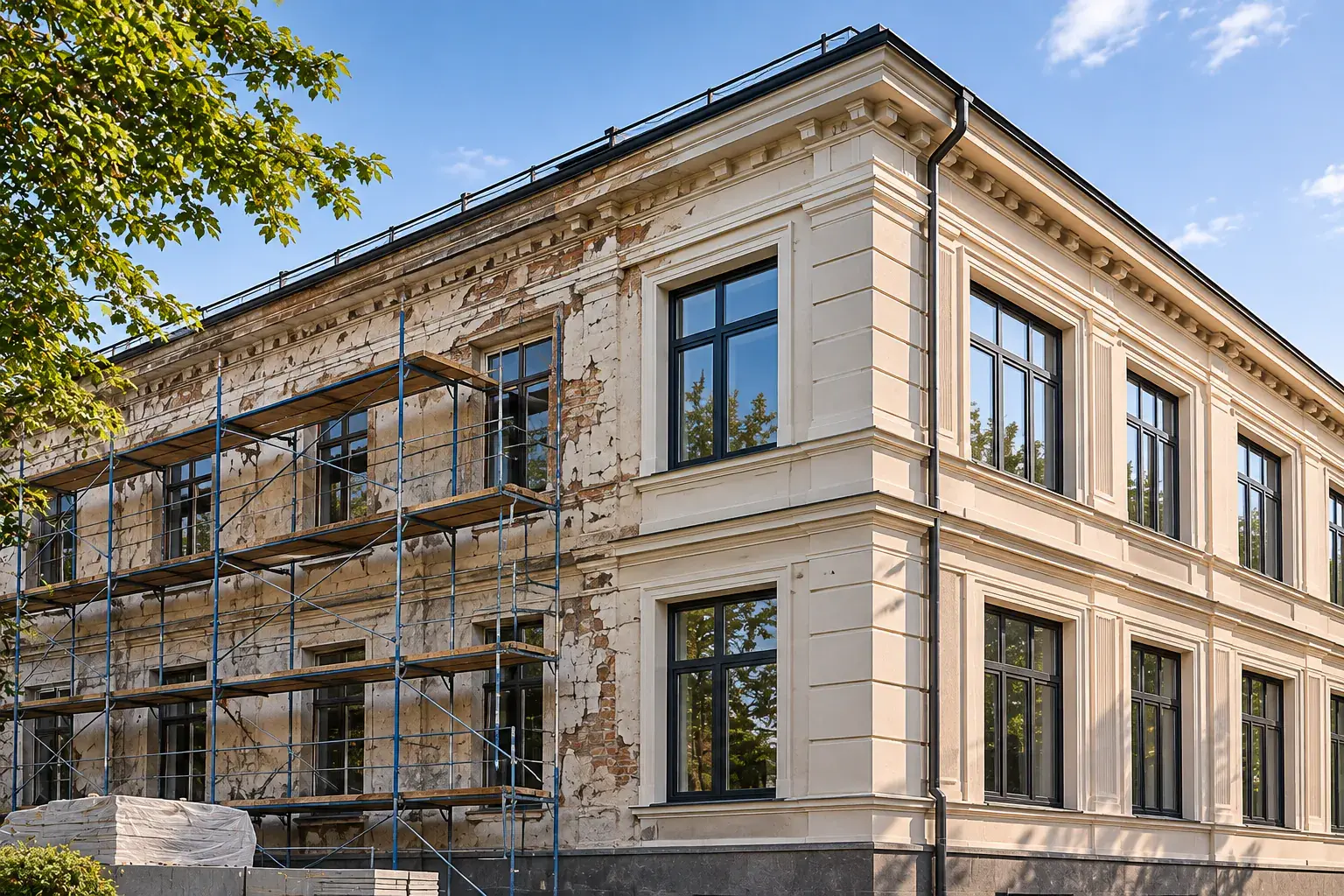
Facade Refurbishment in Dubai
Facade refurbishment in Dubai: survey of existing walls and fixings, new cladding design for heat and humidity, approvals and installation with supervision.
- 10+
- Years of experience
- 15
- Specialists
- 6
- Disciplines
- 90+
- Projects
When facade refurbishment is needed
Owners usually decide on a new facade for one or more of these reasons.
- 01The building looks dated or no longer matches its new use
- 02Cladding, stone or render is loose and could fall
- 03Rooms overheat and cooling bills are high
- 04Water and dust get in through joints and around windows
- 05Windows, curtain walls or the entrance need replacing
- 06Cracks and rust stains point to corroding reinforcement behind the finish
Survey of the substrate and design
A new facade is only as good as what it is fixed to. Engineers check the walls, slab edges and existing anchors, test pull-out strength where needed and look for concrete damage and corroded reinforcement, which is common on Dubai facades exposed to salt air. Defects found here are repaired before the new system goes on.
The architectural design is then developed into working details: fixing brackets, movement joints, interfaces with windows and roof, drainage of the cavity and fire stopping between floors. These details decide how the facade will perform for years.
Systems commonly used
The choice depends on the building type, the budget and the look you want. All external cladding materials must meet the current fire safety requirements of the UAE Fire and Life Safety Code, and we select products on that basis.
- Ventilated rainscreen facades with porcelain, fibre cement or metal panels
- Insulated render systems on block walls
- Natural or engineered stone cladding
- Glazing: curtain walls, shopfronts and entrance canopies
- Shading elements: fins, louvres, screens and frames
Facades in Dubai's climate
Intense sun, high surface temperatures, humidity and dust put a facade under constant stress. Materials expand and contract daily, so movement joints and fixings must allow for it. Insulation and shading reduce heat gain, and high-performance glazing keeps the interior comfortable without overloading the cooling system.
Near the coast, salt air attacks metal fixings and concrete. We specify corrosion-resistant brackets and anchors and details that keep water away from the wall behind the cladding.
How the works go and what affects cost
Facade refurbishment usually needs a developer or community NOC and a permit from the authority responsible for the area, since it changes the building's appearance. Works are carried out from scaffolding or access platforms, floor by floor, while the building stays in use. Cost depends on the facade area, the chosen system, the condition of the substrate, access and the amount of glazing replaced.
How we run a project
A clear route from the first meeting to handover of the finished building.
- 1
Consultation & site assessment
We discuss the brief, budget and constraints, then survey and measure the site.
- 2
Architectural design
We develop the concept and a full set of project documentation.
- 3
Approvals & permits
We clear the government approvals and obtain the required permits.
- 4
Estimate & planning
We prepare a detailed cost estimate, a work schedule and a delivery plan.
- 5
Construction & handover
We build and supervise on site, then hand over the finished building with full documentation.
Questions and answers
Short answers to the questions clients ask most often before a project starts. If yours is not here, write to us and we will advise on your project.
Can the facade be refurbished without replacing the windows?
Yes, if the windows are in good condition. The new cladding is detailed around the existing frames, but the joints between them must be resealed.
Which facade works best in a hot climate?
A ventilated rainscreen with insulation behind it is usually the most effective, because the air gap carries heat away. The final choice depends on the building and budget.
Do I need approval to change the facade?
In most cases yes. A change in appearance typically requires a developer NOC and an authority permit, and cladding materials must comply with fire safety requirements.
Can the building stay occupied during the works?
Yes. We work from outside, protect entrances and windows, and plan noisy work in agreed hours.
Every remarkable project begins with a first step
From concept to delivery — we create architecture that unites aesthetics, function and engineering precision.