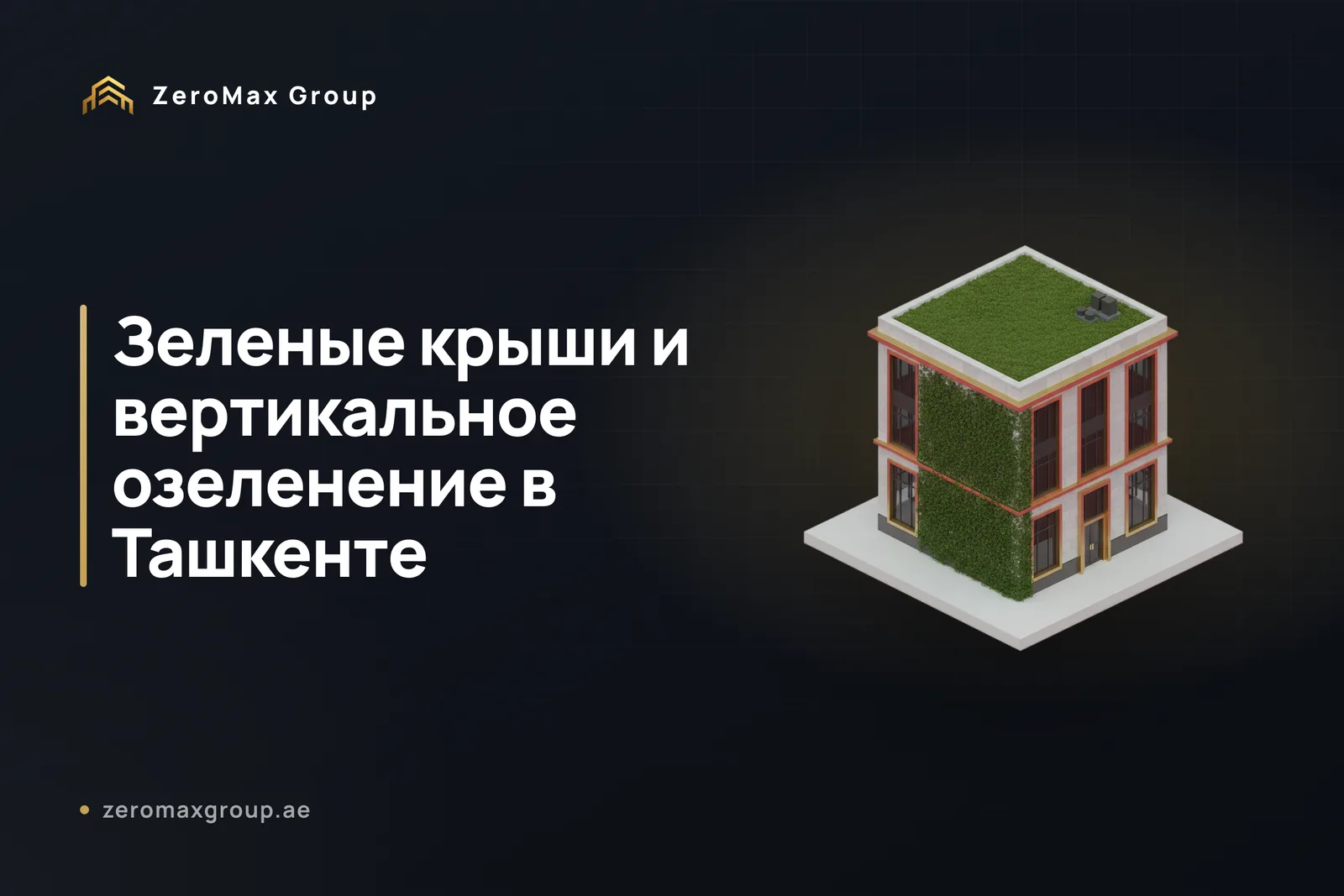
Green Roofs and Vertical Gardens in Tashkent – A Luxury or a Necessity for Cooling Buildings?

Summer in Tashkent puts any facade to the test: by midday, roofs and walls get so hot that equipment inside runs at its limit, and air-conditioning bills climb along with the temperature outside. Green roofs and vertical gardens in Tashkent are increasingly discussed not as a designer's whim but as a practical tool for reducing the thermal load on a building. The only question is how realistic this is under local conditions and what lies behind the pretty picture of plants on a roof.
Why Tashkent Makes Roof Greening Especially Relevant
The capital's climate is sharply continental: hot, dry summers, intense solar radiation, and a noticeable gap between daytime and nighttime temperatures. Dense development in the city center and new districts amplifies the urban heat island effect – asphalt, concrete, and roofs soak up heat during the day and release it at night.
As a result, even a well-insulated building takes on extra load from above. Air conditioners run longer, equipment wears out faster, and the indoor climate on upper floors is noticeably worse than on lower ones. Greening lets you intervene at the level of the building envelope itself, rather than just fighting the consequences indoors.
Dust storms and dry air are a separate factor. Vegetation partly traps dust, raises humidity in the surrounding area, and makes time spent on accessible roofs and terraces more comfortable.
What Exactly a Green Roof Delivers: The Physics Behind It
The effect of greening isn't magic – it comes down to simple mechanisms. The plant and substrate layer acts as additional insulation, while evaporation of moisture from leaves carries away part of the heat – the same principle that cools a person through sweating.
- Shading the surface. The roof assembly isn't heated directly by the sun's rays.
- Thermal inertia. The substrate smooths out daily temperature swings, reducing peak loads.
- Evaporative cooling. Plants spend energy on transpiration rather than on heating the structure.
- Membrane protection. Waterproofing suffers less from UV and temperature fluctuations.
Keep in mind: greening doesn't replace insulation and ventilation. It's an addition to a well-designed envelope, not a substitute. If the building already has issues with thermal insulation or cold bridges, those should be addressed first – sometimes through an inspection and seismic assessment of the structure's condition.
Types of Greening and What Actually Works in Our Conditions
Not every solution is equally applicable. Let's go through the main options found on projects in Uzbekistan and the region.
| Type | Load on the Structure | Maintenance | Where It Fits |
|---|---|---|---|
| Extensive roof (sedums, grasses) | Moderate | Minimal | Flat roofs of warehouses, production facilities, parking garages |
| Intensive roof (shrubs, trees) | High | Regular | Accessible roofs of business centers, hotels |
| Vertical greening (modules, climbing plants) | Local, on the facade | Medium | Lobbies, parking structures, facades without solid windows |
| Mobile planters and containers | Point loads | Medium | Terraces, entrance areas, temporary solutions |
For a dry, hot climate, choosing drought-tolerant species and planning irrigation carefully is critical. The simple logic of "let's plant something green" doesn't work here: plants either survive thanks to automation or die in the very first season.
The Economics: Luxury or a Smart Investment?
Treating greening as purely a cost line is a mistake. There's another side to the equation – the effects you see in operation.
- Lower peak load on the cooling system during hot months.
- Longer service life for waterproofing and the roof covering.
- Less noise from rain and the surrounding environment.
- Added value for tenants and buyers.
That said, the cost items are real too: reinforcing load-bearing structures, drainage, irrigation automation, maintenance. The final decision depends on what matters more to the client – image or operational savings. Often a combination wins: part of the roof is made intensive, part extensive, and the facade is supplemented with local modules.
Structural Requirements: What You Can't Ignore
Roof greening is a load the structure must carry permanently, not occasionally. Before work begins, you need to understand the building's actual safety margin.
- Inspection of load-bearing elements. Assessing the load reserve, condition of slabs and joints.
- Calculating the added weight. Wet substrate is heavier than it looks.
- Drainage and water removal. Standing water is unacceptable – it destroys both the roof and the plants.
- Waterproofing and root barrier. Without a barrier, roots will find the weak spot.
- Safety and access. Maintenance requires walkways and railings.
This is precisely the stage where it often turns out the project requires reconstruction rather than just "greening." That's where building and structure reconstruction with detailed design of every component comes in.
How Vertical Greening Works on a Facade
Vertical systems solve a different problem: they shield walls from direct sun and reduce facade heating. For Tashkent, this is especially valuable on south- and west-facing walls, which take the brunt of solar exposure.
Options vary in complexity. Climbing plants on supports are the most affordable solution, but they need time to grow and require monitoring to keep them in check. Modular systems with pre-planted cells deliver fast results but cost more and need irrigation and maintenance.
The key point is how the system attaches to the facade. A mounted system must not block wall ventilation, cover windows, or reduce natural light. On densely built sites, this is resolved during architectural design, while the facade can still be adjusted.
Water and Irrigation: The Bottleneck of Every Project
In Tashkent's conditions, irrigation is the biggest risk. Without automation, plants don't survive, and manual watering by staff almost always ends the same way: initial enthusiasm, then forgotten sections and dry patches.
- Drip irrigation with moisture sensors.
- Storage tanks and water reuse.
- Drought-tolerant species that reduce water demand.
- Seasonal adjustment of the irrigation schedule.
Cutting corners on the irrigation system means losing the entire investment in a single hot season. This is one case where the engineering side matters more than the decorative one.
Regulatory Side and Approvals
Greening roofs and facades touches several sections of project documentation at once: structural design, fire safety, drainage, and sometimes site improvement. In Uzbekistan, requirements for such solutions rest on current norms, and the approval procedure depends on the type of facility.
If the project involves changing a facade or creating an accessible roof, it goes through expert review in the standard manner. We covered this process in detail in our piece on expert review of project documentation in Uzbekistan – the logic is the same, with additional sections on loads and irrigation.
Clients should understand upfront: approval isn't a formality but a way to avoid rework. A full set of project documentation and cost estimates can be ordered through project and estimate documentation.
Common Mistakes When Starting a Greening Project
Most failures aren't about the plants – they come from decisions made during planning.
- Greening is done without a preliminary structural inspection.
- The weight of wet substrate isn't calculated.
- Drainage is skimped on, resulting in standing water.
- Species unsuited to heat and drought are planted.
- No budget is set aside for maintenance and plant replacement.
Another mistake is treating greening in isolation from the other systems. Roof, facade, ventilation, and cooling work together, and they need to be designed in a coordinated way. An example of this integrated approach can be seen in completed projects – for instance, in the resort zone, where climate and environmental comfort were part of the brief.
Where to Start If You're Considering This Kind of Project
The sequence is logical and predictable.
- Building inspection. Assess load-bearing capacity and the condition of the roof and facade.
- Brief. What you want to achieve: image, indoor climate, savings.
- Concept and calculations. Greening type, loads, irrigation, maintenance.
- Project documentation. Sections on structural design, drainage, site improvement.
- Implementation and author's supervision. Quality control at every stage.
For existing buildings, the first step is turnkey renovation with inspection and subsequent adaptation of the roof or facade. This approach reduces the risk that greening remains a beautiful but non-functional element.
So Is It a Luxury or a Necessity?
The answer depends on the facility. For a production building with a large flat roof, extensive greening is more of an engineering solution to reduce thermal load. For a hotel or business center, it's also about image and guest comfort. For a private house, it's about budget and willingness to maintain it.
But there's a general trend: as urban temperatures rise, greening is no longer an option "for the select few" – it's becoming part of sound building envelope design. Especially since solutions exist for different budgets, not just the premium segment.
The Bottom Line
Green roofs and vertical gardens in Tashkent work if you approach them as an engineering challenge rather than decor. You need inspection, load calculations, drainage, irrigation, and maintenance. Without that, the project turns into an expensive flower bed that won't survive the summer.
If you're planning new construction or reconstruction, it makes more sense to build these solutions into the design stage – that way they cost less and are factored into structural calculations. The specialists at ZeroMax Group can help you assess what's actually feasible for your specific site. Submit a request – and we'll propose a step-by-step plan with timelines and scope of work.
The Economics: What a Green Roof Costs and When It Pays Off
Talk about the benefits of greening almost always hits the budget question. And here it's important not to confuse two very different things: the cost of installation and the cost of operation. The first is a one-time, noticeable expense; the second stretches over years and depends heavily on how well everything was done at the start.
Roughly speaking, a green roof costs several times more than a conventional flat one. The difference adds up across several layers that a standard roof simply doesn't have: high-reliability waterproofing, drainage, a filter layer, the substrate itself, plants, and often an irrigation system too. Vertical greening is even trickier on price – modular systems with mounts, automatic irrigation, and fertigation cost considerably, especially on a multi-story facade.
But the economics don't come down to upfront investment alone. Then comes the part that usually gets overlooked:
- reduced load on air conditioning during hot months – the electricity bill drops not by a few percent but by a substantial share, especially on upper floors;
- longer service life for the roof membrane itself – it isn't baking under direct sun or enduring extreme temperature swings, so it needs repair less often;
- lower peak loads on ventilation and equipment, which delays replacement;
- sound absorption – substrate and plants muffle street noise, which matters for buildings along major roads.
Payback is a flexible concept. For a private home with an accessible roof or rooftop terrace, the green layer can pay for itself through comfort and cooling savings. For a commercial building, we're talking more like a ten-year horizon, and here the deciding factors aren't just money but energy-efficiency requirements, which are gradually tightening in large cities.
| Solution Type | Main Installation Costs | What It Delivers in Operation |
|---|---|---|
| Extensive green roof | Substrate, drainage, low-maintenance plants, reinforced waterproofing | Thermal insulation, membrane protection, minimal upkeep |
| Intensive green roof | Reinforced structure, irrigation, full substrate layer, drainage | Usable space, noticeable cooling, comfortable terrace |
| Vertical greening (modular) | Frame, modules, automatic irrigation, plant nutrition | Facade shading, reduced wall heating, visual impact |
A separate cost line that's often remembered last is maintenance. A roof with plants doesn't take care of itself: it needs inspections, drain cleaning, replanting of anything that dies off, and irrigation monitoring. If that's neglected, savings quickly turn into repairs.
Mistakes That Make Greening Fail or Damage the Building
A green roof isn't a case where you can improvise. Most failures aren't about climate – they come from decisions made during design or later during operation.
The first and most costly mistake is cutting corners on waterproofing. Plant roots, constantly moist growing media, and freeze-thaw cycles break down weak membranes, and a leak is discovered too late, once water has already reached the structural slabs. Fixing it means tearing the entire roof assembly apart.
The second is choosing the wrong plants. In Tashkent's conditions, betting on moisture-loving ornamental species with no drought tolerance is a losing game: they scorch in summer, and the whole cooling effect goes with them. What works here are succulents, drought-tolerant grasses, and native species that handle the heat without daily watering.
The third is ignoring load-bearing capacity. Water-saturated growing media weighs a lot, and not every roof is designed for the extra load. This is especially true of older buildings, where the safety margin is unknown. Starting a green roof project without a structural engineer's calculation is a gamble.
The fourth mistake applies specifically to vertical systems. Modules with automated irrigation need a stable water and power supply. If the pump goes down, the plants on the facade die within days, and the structure just hangs there as dead weight. That's why backup power and irrigation resilience aren't a luxury — they're a must.
And finally, drainage. Clogged or poorly designed, it turns the roof into a bathtub full of plants. Water stagnates, roots suffocate, and the load on the structure keeps growing. Regularly flushing the drainage layers is the kind of routine you can't escape if you want the whole thing to last for years.
To sum it up without sugarcoating: greening in Tashkent is neither a cure-all nor a decorative trend — it's an engineering solution with its own price tag, requirements, and scope of responsibility. Where it's designed for the local climate and real loads, it pays off in comfort and lower temperatures. Where it's done just for the look, it turns into a problem that later has to be dismantled layer by layer.
An Engineering Breakdown: What a Green Roof Really Costs in Uzbekistan's Conditions
Before counting the savings on air conditioning, it's worth taking an honest look at the structure. Everything growing on the roof rests on several layers: waterproofing, root barrier, drainage, filter membrane, growing media, and only then the plants. Each layer adds weight and cost. And while in a temperate climate the load often isn't considered critical, in Tashkent you also have to factor in seismic activity — something you can't afford to overlook.
Saturated growing media at the height of the watering season weighs a lot. A water-soaked layer 10–15 cm thick is comparable in mass to several bags of cement per square meter. For an accessible roof, this means reinforcing load-bearing structures, recalculating loads, and in some cases revising the entire design. That's why the question of luxury versus necessity comes down not to aesthetics but to engineering calculations.
The root system is a story of its own. It looks for water and cracks at the same time. A mistake in the root barrier costs more than the green layer itself: a leak in year five wipes out all the savings. In Tashkent's reality, you can add sharp temperature swings that push materials to their limits, plus summer drought, when the growing media loses moisture faster than it can be replenished.
How to Choose the Right Type of Greening for a Specific Building
Not every roof can support a full-fledged garden. But that's no reason to abandon the idea entirely — the approach just has to match the structure, the building's purpose, and the maintenance budget. Below is a comparison to help you get your bearings.
| Type | Layer thickness | Weight (saturated) | Maintenance | Best suited for |
|---|---|---|---|---|
| Extensive roof | 5–15 cm | moderate | minimal, occasional watering | residential buildings, offices with load restrictions |
| Semi-intensive | 15–30 cm | above average | regular watering and care | buildings with an accessible terrace |
| Intensive (garden) | from 30 cm | significant | constant care | low-rise properties where the load allows |
| Vertical greening | — | depends on the system | watering and pruning | facades, blank walls, parking structures |
Note that vertical greening stands apart in the table. It doesn't require recalculating roof loads, it's mounted on the wall, and it works where the roof is out of reach — on blank end walls or utility facades, for example. In Tashkent's dense urban fabric, this is often the fastest way to shade a surface.
But vertical systems have their own weaknesses. Plants in modules are limited by the volume of growing media, which means they depend more heavily on irrigation. Without a drip line, they'll simply burn up in a couple of weeks in summer. And there's another point rarely mentioned in promotional brochures: greenery on a facade creates an ideal environment for insects and requires constant monitoring so the wall doesn't turn into a breeding ground.
So the choice is always a compromise between cooling effect, maintenance cost, and the technical constraints of a specific building shell. There's no universal recipe, and promoting one type over another would be dishonest.
The Economics Without Illusions
Calculating a green roof's payback based solely on temperature reduction is a losing proposition from the start. Installation costs are high, and the effect depends on the season, planting density, and layer thickness. Still, there are indirect benefits that work fairly consistently in Tashkent's climate.
Extending the service life of waterproofing is the first argument. The membrane under a vegetative layer never sees direct UV and doesn't heat up to peak temperatures. The temperature swings that cause it to age and crack are smoothed out. As a result, roof repairs are pushed back by years — and that's already a tangible saving on maintenance.
The second point is reducing peak demand on air conditioners during the hottest hours. It's not that they'll stop running — it's that they'll have to work less. For offices and buildings with a constant human presence, the difference adds up over the season.
And the third, less obvious plus is stormwater management. During rains, the green layer retains some of the water, reducing the load on storm drains and lowering the risk of flooding the surrounding area. For central Tashkent with its dense development, this isn't an abstraction — it's a real problem on days of heavy rainfall.
The conclusion is simple: a green roof in Tashkent is neither a luxury nor a cure-all. It's an engineering solution with specific benefits and very specific costs. And it should be adopted based on calculations, not on a picture in a glossy magazine.