
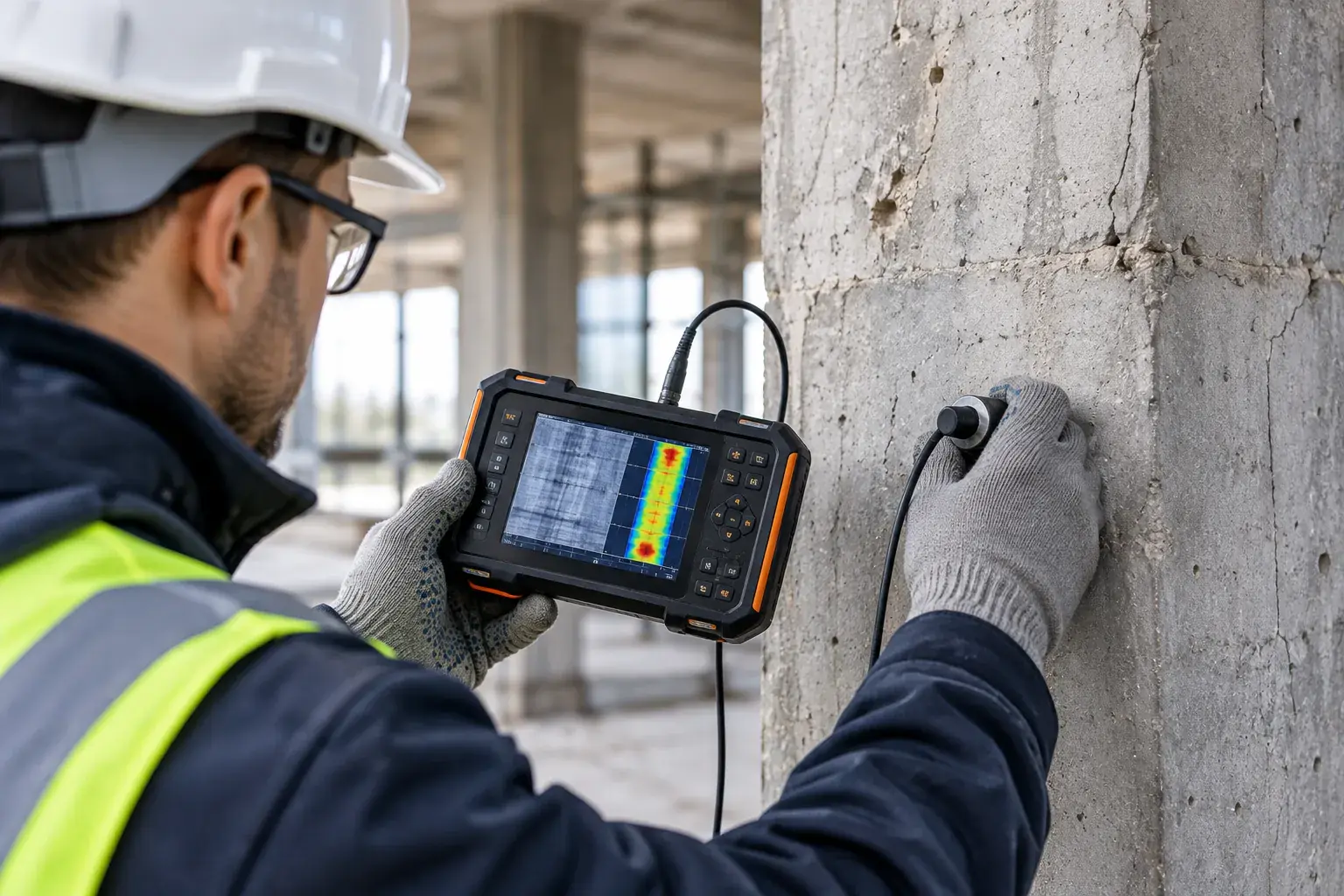
Non-Destructive Concrete Testing in Dubai
Non-destructive concrete testing in Dubai: rebound hammer, ultrasonic pulse velocity, rebar and cover scanning, half-cell corrosion survey and strength mapping.
- 10+
- Years of experience
- 15
- Specialists
- 6
- Disciplines
- 90+
- Projects
Methods used
Each method answers a different question, so a survey usually combines several of them.
- 01Rebound hammer for fast surface hardness readings over large areas
- 02Ultrasonic pulse velocity to assess uniformity and internal defects
- 03Cover meter and rebar scanning to locate bars and measure cover
- 04Half-cell potential survey to map the risk of reinforcement corrosion
- 05Detection of voids, honeycombing and poorly compacted zones
- 06Strength mapping across the element, calibrated with cores where needed
When non-destructive concrete testing is needed
On new construction it is used to check suspicious pours, to confirm uniformity of large elements and to verify concrete cover before handover. On existing buildings it is the first step of almost every structural assessment, before an additional floor, a change of use or a major renovation.
In Dubai a large share of the work concerns durability rather than strength. Cover depth and half-cell readings show where reinforcement is at risk from chlorides long before cracks and rust stains appear, which allows repairs to be targeted and planned.
How the measurements are taken
The engineer selects the elements and the test grid based on drawings and a walk-through. The concrete surface is prepared at each test point, and readings are taken in a fixed pattern so the results are comparable across the building. Where several methods are used on the same element, the results are cross-checked.
Work goes element by element without heavy equipment, so it can be done in occupied buildings and on active sites with little disruption. Results are processed into tables and maps that show where concrete is uniform and where it is not.
Limits of indirect methods
Non-destructive methods measure properties related to strength, not strength itself. Surface carbonation, moisture, aggregate type and the hot surface of concrete exposed to the sun all affect the readings. That is why reliable conclusions combine NDT with a small number of cores used for calibration.
We state clearly in the report which results are direct and which are estimated, so decisions are not made on more precision than the methods can give.
What affects scope and cost
The number of elements and test points, the methods required, access (heights, finishes to remove, occupied areas) and the need for calibration cores determine the scope and cost. We agree the programme after reviewing the task and the building.
How we run a project
A clear route from the first meeting to handover of the finished building.
- 1
Consultation & site assessment
We discuss the brief, budget and constraints, then survey and measure the site.
- 2
Architectural design
We develop the concept and a full set of project documentation.
- 3
Approvals & permits
We clear the government approvals and obtain the required permits.
- 4
Estimate & planning
We prepare a detailed cost estimate, a work schedule and a delivery plan.
- 5
Construction & handover
We build and supervise on site, then hand over the finished building with full documentation.
Questions and answers
Short answers to the questions clients ask most often before a project starts. If yours is not here, write to us and we will advise on your project.
Does non-destructive testing damage the structure?
No. At most, the surface is lightly ground at test points, and finishes may need local removal for access.
How accurate are the measurements?
On their own, indirect methods give an estimate. Calibrated with cores from the same structure, they become reliable enough for engineering decisions.
Can you find reinforcement in a wall without opening it?
Yes. Scanning shows bar positions, spacing and cover depth, which is also useful before drilling or cutting openings.
Can you tell whether the rebar is corroding without breaking out concrete?
A half-cell potential survey shows where corrosion is likely, and a few small openings then confirm the actual condition.
Every remarkable project begins with a first step
From concept to delivery — we create architecture that unites aesthetics, function and engineering precision.